
Completing your IGCSE is a major achievement. You’ve worked through exams, coursework, and late-night revisions, and now you’re standing at a new crossroads.
But here’s the truth: what you choose after IGCSE in Pakistan can shape your university journey, career direction, and even your confidence as a learner.
For students completing IGCSE in Pakistan, the transition to A Levels, IB, Intermediate, or other pathways can feel overwhelming. And in that confusion, many students make avoidable mistakes.
Let’s talk about the five most common ones and how you can avoid them.
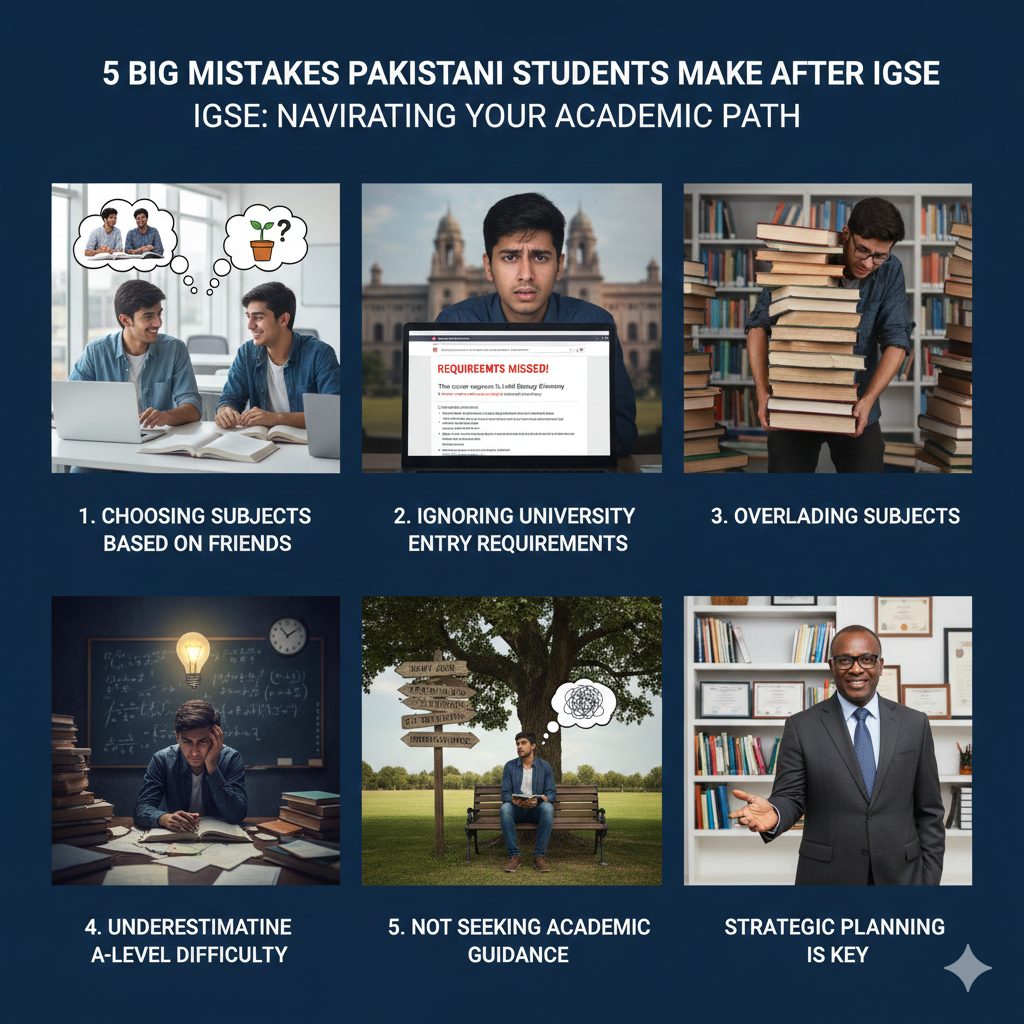
1. Choosing Subjects Based on Friends After IGCSE in Pakistan
It’s tempting. Your friends are taking certain subjects, and you don’t want to feel left out. Maybe everyone is choosing Pre-Med or Pre-Engineering. Maybe your circle is leaning toward Business.
But subject selection is not a social decision; it’s a strategic one.
Choosing subjects because your friends are taking them can lead to:
- Loss of interest halfway through A Levels
- Poor performance in subjects you never truly liked
- Stress and burnout
How to Avoid It:
Ask yourself:
- What subjects did I genuinely enjoy during IGCSE?
- What careers interest me?
- What subjects align with my strengths?
Your academic path is personal. Build it around your goals, not someone else’s.
2. Ignoring University Entry Requirements
Many students only start thinking about university requirements in their final A Level year, and by then, it can be too late.
Different universities and countries have specific subject prerequisites. For example:
- Medicine often requires Biology and Chemistry.
- Engineering requires Mathematics and Physics.
- Business schools may prefer Mathematics.
If you choose the wrong subject combination early, you may limit your university options later.
How to Avoid It:
Before finalizing subjects:
- Research entry requirements for at least 3–5 potential career paths.
- Look at university websites (local and international).
- Talk to academic advisors or counselors.
Make choices with the end goal in mind.
3. Overloading Subjects After Completing IGCSE in Pakistan
Some students think:
“If I take more subjects, I’ll look smarter or more competitive.”
This mindset can backfire.
A Levels and post-IGCSE programs are significantly more demanding than IGCSE. Taking too many subjects can lead to:
- Constant stress
- Lower grades across all subjects
- Poor time management
- Mental exhaustion
Quality matters more than quantity.
How to Avoid It:
Choose a manageable number of subjects based on:
- Your academic ability
- Your time management skills
- University requirements
It’s better to excel in three strong subjects than struggle in five.
4. Underestimating A-Level Difficulty
One of the biggest shocks for students is the jump in difficulty from IGCSE to A Levels.
A Levels required:
- Deeper conceptual understanding
- Analytical writing
- Independent study habits
- Advanced problem-solving
Many students assume it will be “just like IGCSE, but slightly harder.” It’s not.
How to Avoid It:
- Start building strong study habits early.
- Review foundational concepts during the break after IGCSE.
- Be mentally prepared for a higher level of academic rigor.
- Seek help early if you struggle; don’t wait until exams approach.
The earlier you adapt, the smoother your transition will be.
5. Not Seeking Academic Guidance:
Perhaps the most overlooked mistake is trying to figure everything out alone.
In Pakistan, many students rely solely on family advice or peer opinions when making decisions after completing the IGCSE. While family input is valuable, academic pathways today are complex and global.
Without proper guidance, students may:
- Choose misaligned subjects
- Miss scholarship opportunities
- Remain unaware of international pathways
How to Avoid It:
- Speak to experienced teachers.
- Consult academic counselors.
- Research thoroughly before making decisions.
Guidance is not a sign of weakness; it’s a sign of strategic planning.
Your Future Starts With Smart Decisions
Completing IGCSE in Pakistan is not the end of your academic journey; it’s the beginning of a more specialized and focused phase.
The choices you make now will influence:
- Your university eligibility
- Your academic confidence
- Your career trajectory
Avoiding these common mistakes can give you clarity, control, and confidence in your next step.
Remember:
Your academic journey is not about following the crowd; it’s about building a path that works for you.
Need Clarity After IGCSE in Pakistan?
Choosing the right subjects and pathway after IGCSE can feel overwhelming, especially when every decision seems to shape your future.
If you want to resit your exam and improve your IGCSE grade, whether it’s IGCSE Chemistry, IGCSE Maths, or IGCSE Biology, the correct guidance and academic support are all you need. W
If you’re unsure about subject selection, A Level preparation, or university planning, getting structured academic support can make a significant difference.
VACE Global provides online tutoring for IGCSE and post-IGCSE students, along with academic guidance to help you transition confidently into your next stage, whether that’s A Levels, IB, or beyond.
Sometimes, the smartest move isn’t guessing, it’s getting guided.
Enroll with the best online tutors to make the best decisions for your academic excellence.
FAQs:
1. What is the best option after IGCSE in Pakistan?
The best option depends on your career goals, university plans, and preferred learning style.
2. Is A Level harder than IGCSE in Pakistan?
Yes, A Levels require deeper understanding, stronger analysis, and more independent study.
3. How many A-level subjects should I take after IGCSE?
Most students choose three subjects to maintain a strong academic balance.
4. Can I switch fields after choosing my A Level subjects?
Switching is possible, but some careers require specific subject combinations.
5. Do Pakistani universities accept IGCSE and A Levels?
Yes, they are accepted with IBCC equivalence certification.