
Transportation in plants is a fascinating and essential process that keeps plants alive, nourished, and growing. It is a crucial topic for O-level Biology and A-level Biology. The Cambridge syllabus includes it every year and is an important part of the biology exams.
From absorbing water and minerals from the soil to distributing food produced in the leaves, plants rely on a highly organized transport system made up of xylem and phloem. Understanding how substances move through these tissues, and the forces that drive them, is crucial for students learning about plant biology. This blog breaks down the complex processes of water absorption, food transport, active and passive transport, and the natural forces that make it all possible, making it easier to grasp and remember.
This comprehensive blog will help you understand with clarity the concept of transportation in plants and all its elements, such as the driving forces and the plant structure that plays a part.
To have access to more well-structured revision notes of O-level subjects, A-level subjects, and IGCSE notes, enroll with VACE Global and get expert guidance with these notes.
Key Takeaway:
- Xylem and Phloem Are Vital: Xylem transports water and minerals upward, while phloem moves food from sources (leaves) to sinks (roots, fruits, or growing tissues).
- Water Moves Mostly Passively: Water absorption occurs via osmosis in root hairs and travels upward through xylem via transpiration pull, root pressure, and cohesion/adhesion.
- Food Transport Is Active: Sugars produced in leaves are actively loaded into phloem and transported to storage or growth sites, requiring energy (ATP).
- Active vs Passive Transport: Passive transport moves substances along concentration gradients without energy, while active transport moves nutrients against gradients using energy.
- Driving Forces Ensure Efficiency: Transpiration pull, root pressure, osmosis, diffusion, and pressure flow work together to maintain hydration, nutrient supply, and growth in plants.
What is transportation in plants?
Transportation in plants is the process by which essential substances, like water, minerals, and food, move from one part of the plant to another. Transportation in plants is a good form of coordination in plants as well. This system is vital because these substances are needed for:
- Photosynthesis: Water and minerals reach the leaves so they can produce food.
- Growth and Development: Nutrients support the formation of new cells, stems, roots, and leaves.
- Reproduction: Energy and nutrients are transported to flowers, fruits, and seeds.
- Maintaining Turgor Pressure and Structure: Water inside cells keeps them firm, helping the plant stay upright and structurally stable.
Plants achieve this movement through two main types of transport:
- Water and Mineral Transport (Xylem): Moves water and dissolved minerals from roots to leaves.
- Food Transport (Phloem): Moves sugars and other nutrients from leaves (where food is made) to other parts of the plant for growth, storage, or energy.
Types of transportation in plants:
Plants transport substances in two main forms:
1. Water Transport:
- Water moves from roots to leaves through the xylem.
- This process is passive, driven by transpiration pull, root pressure, and capillary action.
2. Food Transport:
- In most plants, food is transported in the form of sugars, mainly sucrose.
- Transport occurs through the phloem, from source (leaves) to sink (roots, fruits, or growing parts).
Water Absorption in Plants:
Water absorption in plants begins in the root hairs, tiny extensions of root cells that increase the surface area for uptake. Water from the soil moves into the root hairs through osmosis, a passive process where water moves from a region of high concentration (soil) to a region of low concentration (root cells). Once absorbed, water travels upward through the xylem to reach stems, leaves, and other parts of the plant, supporting vital functions like photosynthesis, nutrient transport, and maintaining turgor pressure.
Process of Water Absorption and Transport:
- Water Uptake by Root Hairs: Water enters root hair cells via osmosis due to a higher water concentration in the soil compared to the root cells.
- Movement to Xylem: Water passes from root cortex cells into the xylem vessels.
- Ascent Through Xylem: Water travels upward to stems and leaves via capillary action, root pressure, and transpiration pull.
- Distribution to Plant Cells: Water reaches all tissues, providing hydration, minerals, and support for photosynthesis.
- Turgor Pressure Maintenance: Water inside cells keeps them turgid, helping maintain structure and growth.
Key Points to Remember:
- Root hairs significantly increase the surface area for water absorption.
- Most water movement is passive, but ions like potassium and nitrate may require active transport.
- Proper water balance is essential for turgor pressure, photosynthesis, and overall plant health.
Food Transport in Plants:
In most plants, food is transported in the form of sugars, primarily sucrose, to provide energy for growth, storage, and reproduction. This transport occurs through the phloem, which moves food from areas of production (sources) to areas of storage or use (sinks). Unlike water transport in xylem, phloem transport is an active process, requiring energy to load and unload sugars effectively.
Process of Food Transport (Source to Sink)
- Photosynthesis in Leaves (Source): Leaves produce sugars during photosynthesis.
- Sugar Loading into Phloem: Sugars are actively loaded into phloem sieve tubes at the source, using energy (ATP).
- Translocation via Phloem: The sugars move through the phloem from high-pressure areas at the source to low-pressure areas at the sink.
- Unloading at the Sink: Sugars are removed from the phloem and transported into storage organs (roots, tubers, fruits) or growing tissues.
- Usage or Storage: Sugars are either metabolized for energy or stored for later use.
Example: In a potato plant, sugars produced in the leaves are transported to the tubers for storage. In fruit-bearing plants, sugars are transported to developing fruits to support growth and sweetness.
The transport system in plants:
Plants have a specialized transport system made up of two main tissues: xylem and phloem. These tissues act like pipelines, moving water, minerals, and food to different parts of the plant. Together, they ensure that the plant stays hydrated, nourished, and able to grow.
- Xylem:
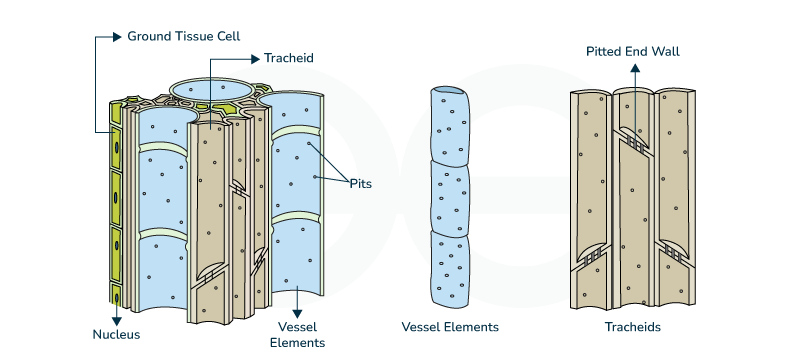
Structure: Xylem consists of tubular, lignified vessels and tracheids, which provide both strength and a pathway for water movement.
Function: Xylem transports water and dissolved minerals absorbed by roots upward to stems, leaves, and flowers. This is crucial for photosynthesis, nutrient distribution, and maintaining turgor pressure in cells.
Mechanism:
- Transpiration Pull: Evaporation of water from leaves pulls water upward.
- Root Pressure: Positive pressure generated in roots pushes water into the xylem.
- Cohesion and Adhesion: Water molecules stick together (cohesion) and to xylem walls (adhesion), helping water rise against gravity.
Example: Water absorbed from soil moves through xylem vessels to hydrate leaves, enabling photosynthesis.
- Phloem:
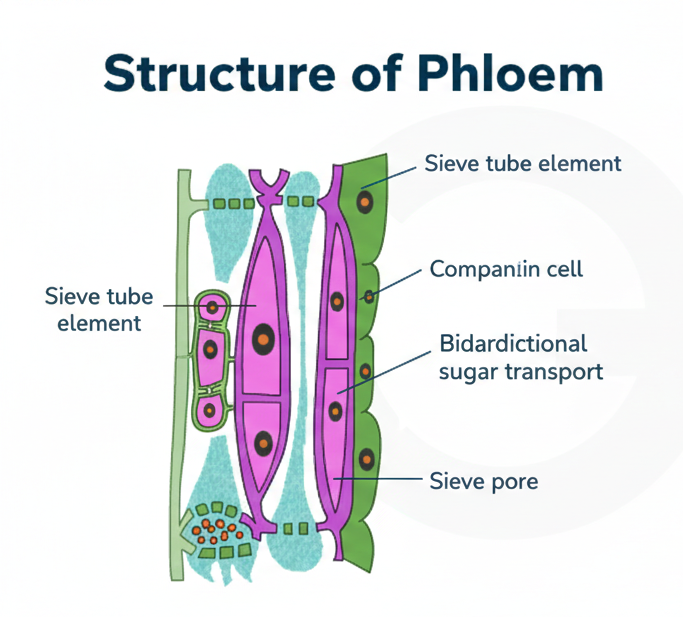
Structure: Phloem is made of sieve tubes, companion cells, and phloem fibers, designed to transport food efficiently.
Function: Phloem carries food (mainly sugars) from the leaves, where it is produced during photosynthesis, to other parts of the plant, such as roots, fruits, and growing shoots.
Mechanism:
- Translocation from Source to Sink: Sugars move from “sources” (like leaves) to “sinks” (like roots or fruits) via pressure flow.
- Bidirectional Movement: Unlike xylem, phloem can move food in both directions, depending on the plant’s needs.
Example: In a carrot plant, sugars produced in leaves travel down the phloem to the carrot root for storage.
Active Transport and Passive Transport in Plants:
Plants rely on both active and passive transport mechanisms to move substances like water, minerals, and nutrients to where they are needed. The difference between the two lies in whether energy is required and the direction of movement.
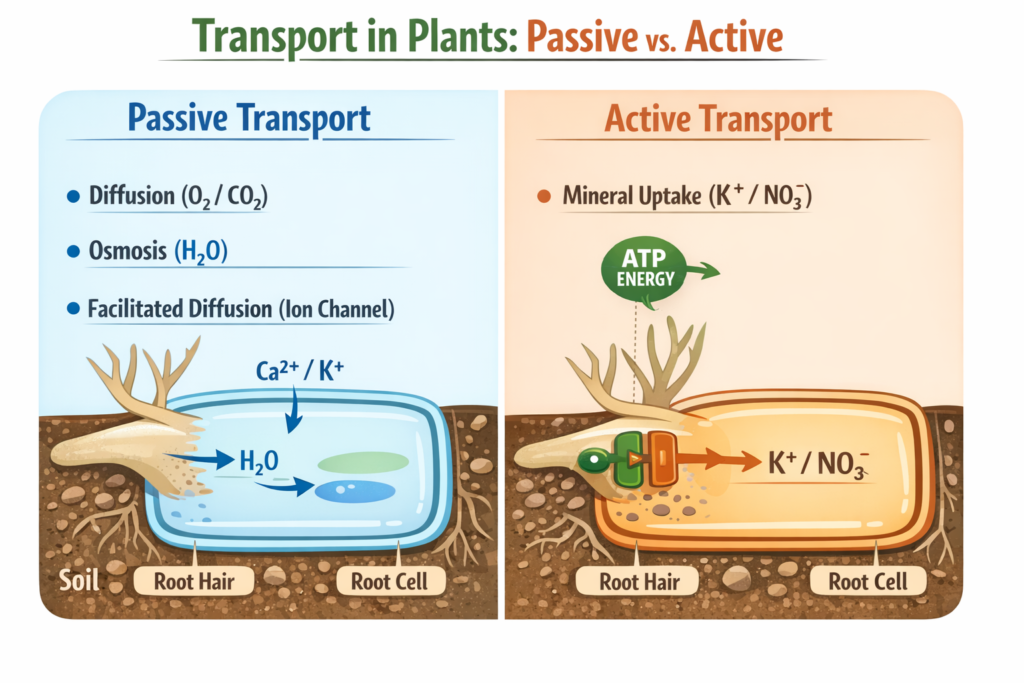
A. Passive Transport
Passive transport is the movement of substances without using energy. Substances move from areas of high concentration to low concentration, following their natural gradient.
Examples:
- Diffusion – The movement of gases such as oxygen (O₂) and carbon dioxide (CO₂) across cell membranes. For instance, CO₂ diffuses into leaf cells during photosynthesis.
- Osmosis: The movement of water through a semipermeable membrane, such as from the soil into root hair cells. Water naturally moves from areas of higher water concentration (soil) to lower water concentration (root cells).
- Facilitated Diffusion: Some ions, like potassium (K⁺) or calcium (Ca²⁺) cannot pass freely through membranes and move via protein channels without energy.
Key point: Passive transport does not require ATP; it relies on natural concentration differences.
B. Active Transport
Active transport is the movement of substances against their concentration gradient, which requires energy in the form of ATP. Plants use this to take in essential nutrients even when their concentration is higher inside the cells than in the soil.
Example:
- Root cells actively absorb minerals like potassium (K⁺) and nitrate (NO₃⁻) from the soil. Even if the soil has a lower concentration than the root cells, energy is used to pump these minerals into the roots.
Why it matters: Active transport ensures that plants get enough minerals to grow and maintain cellular functions, even in nutrient-poor soils.
Driving forces of transportation in Plants:
The movement of water, minerals, and food in plants is not random—it is powered by several natural forces. These forces work together to ensure that water travels from roots to leaves through the xylem and that sugars move from leaves to other parts of the plant via the phloem. Understanding these driving forces helps explain how plants maintain their vital processes even against gravity and concentration differences.
- Transpiration Pull: Water evaporates from the surface of leaves, creating a negative pressure that pulls water upward through the xylem from the roots.
- Root Pressure: Roots generate a positive pressure by actively absorbing minerals, which pushes water upward through the xylem, especially when transpiration is low.
- Osmosis and Diffusion: Water and minerals enter root cells through osmosis and diffuse into the xylem, moving from areas of high to low concentration.
- Pressure Flow: Sugars produced in leaves (the source) are transported to roots, fruits, and growing tissues (the sink) via phloem, driven by pressure differences created through active loading and unloading of sugars.
Conclusion:
The transport system in plants is essential for survival, ensuring water, minerals, and food reach every part of the plant. Understanding xylem and phloem transport, along with active and passive transport mechanisms, helps students grasp how plants grow, reproduce, and respond to environmental challenges.
At VACE Global, we make complex biology concepts easy to understand. Our expert tutors break down topics like transportation in plants into simple, visual, and interactive lessons, helping students not just memorize but truly grasp the underlying principles. With personalized guidance, real-world examples, and exam-focused strategies, learning biology becomes engaging and effective.
Ready to master biology with VACE Global? Enroll now and connect with our expert tutors to unlock your full potential!
FAQs:
Q1. How is water transported in plants?
Water is absorbed by roots and transported upward through xylem via transpiration pull, root pressure, and capillary action.
Q2. How is food transported in plants?
Food, mainly sugars, is transported from source to sink via phloem using pressure flow.
Q3. What is the difference between active and passive transport in plants?
- Passive transport does not require energy (e.g., diffusion, osmosis).
- Active transport requires energy to move substances against a gradient (e.g., mineral uptake).
Q4. What are xylem and phloem?
- Xylem transports water and minerals upward.
- Phloem transports food from leaves to other parts of the plant.