
The advancements in the education industry have led students to make tough choices, such as which one to choose between the British curriculum vs the American curriculum. Both the American curriculum and the British curriculum are the most popular and well-respected educational programs taught by international schools around the globe.
This blog will help you analyze and evaluate all the factors and elements of the British curriculum vs the American curriculum, so that you can decide which one would be the best choice for you. You can learn each of these curricula in detail at VACE Global.
Why do you need to compare the British curriculum vs the American Curriculum?
The debate and comparison of the British curriculum vs the American curriculum is necessary for parents and students. Choosing the right curriculum is one of the most important decisions that shape a student’s academic journey and future opportunities. The British and American curricula are both globally recognized, but they differ in learning style, assessment methods, and university preparation. By comparing the two, parents and students can identify which system best suits their learning goals, whether that’s structured academic depth or flexible, skill-based exploration. Understanding these differences ensures you make an informed choice that aligns with your child’s strengths, future aspirations, and study destination.
Before concluding, let’s dive deeper into each curriculum and its factors.
The British Curriculum: What makes it different?
- The British education system:
The British education system is also known as the National Curriculum for England, owned by the government of the UK. This curriculum is widely recognized and implemented. The two major components of the British curriculum are the IGCSE (International General Certificate of Secondary Education) and A-level qualifications.
- IGCSE: The IGCSE is a two-year program designed for students aged 14 to 16. It covers a wide spectrum of subjects such as languages, sciences, mathematics, humanities, and creative arts. Throughout the program, students study multiple subjects and complete examinations at the end. Serving as a strong academic foundation, the IGCSE prepares learners for advanced studies and future academic success.
- A-Levels: After completing the IGCSE, students can advance to A-level qualifications, a two-year program that emphasizes subject specialization. In A-levels, students typically select three or four subjects to study in depth, culminating in final examinations. This qualification offers a deeper academic understanding of chosen fields and is highly respected by universities worldwide for admission consideration.
- Key stages: The key stages that the British curriculum follows are:
- The foundation stage or the Early Years Foundation System (EYFS)
- Key stage 1 for children five to seven years old, introducing basic reading and writing skills.
- Key stage 2 targets the seven to eleven-year-olds and is the final primary stage. By the end, children become independent readers and writers.
- Key stage 3 is the beginning of secondary education for the age group of eleven to fourteen years. Where students study a broad range of subjects by subject-expert teachers.
- Key stage 4 is for ages fourteen to sixteen, and by the end of this stage, students appear in the GCSE exams. Students study core subjects as well as optional subjects.
- Key stage 5 is the final two school years and involves the study of career-related fields and specialized subjects.
- Subjects and Assessments: The British education system encourages subject specialization from an early stage. At the IGCSE level, students usually choose around five to seven subjects from a broad range of core and elective options.
In the A Level stage, students usually narrow their focus to three or four subjects aligned with their intended university pathway. This level of specialization is beneficial for students with clearly defined academic strengths or interests, though it does require more focused decision-making at an earlier age.
- Global Recognition and university entrance:
The International British Curriculum is widely recognized across the globe, with IGCSE and A Level qualifications accepted by universities in the UK, Europe, Canada, Australia, South Africa, and many other countries. A Levels often qualify students for direct entry into undergraduate programs, while AS Levels can strengthen applications for foundation courses. Renowned for its academic rigor and global credibility, the British Curriculum continues to be a preferred choice for students seeking international education opportunities.
- Learning style and teaching approach: The International British Curriculum adopts a more academic and exam-oriented approach, especially in the higher grades. It places strong emphasis on analytical thinking, logical reasoning, and a thorough understanding of content. Students are encouraged to engage deeply with their subjects and build independent learning skills. Although some subjects include coursework and practical elements, formal examinations remain the main form of assessment.
- Online school compatibility: The International British Curriculum is primarily exam-focused, yet its structured framework and subject specialization make it ideal for students who excel in focused, independent learning.
The American Curriculum: Why it stands out?

- The American education system:
The American educational system encompasses various frameworks, and one of them is AP (Advanced Placement). AP courses are college-level courses offered in high school that allow students to get college credits or advanced placement in college. They offer SATs.
- SATs: The SAT is a standardized exam commonly required for college admissions in the United States. It evaluates students’ abilities in critical reading, writing, and mathematics. Usually taken during the junior or senior year of high school, SAT scores play a significant role in college and university admission decisions. The test gauges a student’s preparedness for college-level academics and often influences eligibility for scholarships and other academic opportunities.
- Subjects and Assessments: The American curriculum provides a broad and flexible framework, especially during high school. Students typically study core subjects such as English, Mathematics, Science, and Social Studies, while also having the freedom to select from a wide variety of electives, from Journalism and Psychology to emerging fields like Artificial Intelligence. For those seeking more academic challenge, Advanced Placement (AP) courses offer college-level study opportunities. This flexibility empowers students to personalize their learning paths according to their interests and future university aspirations.
- Global Recognition and university entrance: The US curriculum is widely accepted by universities across the United States and numerous institutions worldwide. Students generally graduate with a high school diploma and may submit SAT or ACT scores as part of their university applications. Taking Advanced Placement (AP) courses can enhance admission prospects and may even earn college credit. Its adaptable framework makes it ideal for students planning to pursue higher education in North America or abroad.
- Learning style and teaching approach: The US curriculum places strong emphasis on critical thinking, participation, and project-based learning. Lessons are often interactive and designed to encourage discussion, collaboration, and creativity. Students are encouraged to explore topics through real-world applications, research assignments, and group projects. This approach supports a broad skillset, preparing learners for both university and the workplace.
- Online school compatibility: The US curriculum, with its credit-based structure and emphasis on continuous assessment, lends itself well to online learning. It allows students to progress at their own pace, complete assignments digitally, and engage in interactive, project-based tasks.
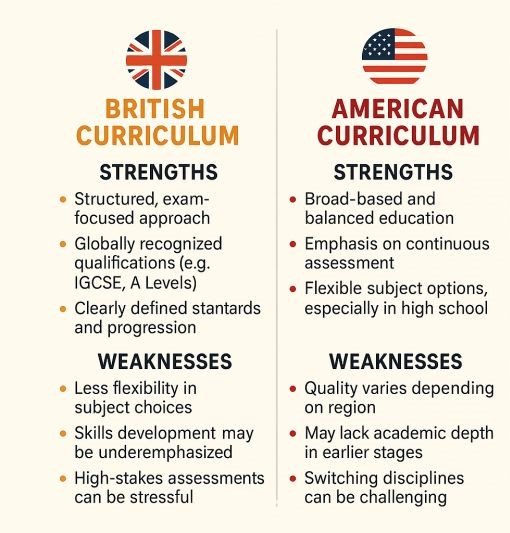
The difference between the American vs British curriculum:
- Education level: The British curriculum divides learning into key stages, while the American system uses grades. For instance, Key Stage 1 covers ages 5–7, aligning roughly with Grades 1–2 in the American system
- Education structure: The American curriculum generally operates on a semester or trimester system, whereas the British curriculum follows a traditional academic year. The American system is known for its flexibility, offering a broad selection of courses and electives, while the British system is more structured, with a standardized curriculum implemented across schools.
- Subject content: The American curriculum offers a broader academic scope, incorporating a diverse mix of subjects such as social sciences, humanities, and the arts. In comparison, the British curriculum prioritizes core academic areas, particularly mathematics, science, and English, while offering fewer elective and cross-disciplinary options.
- Testing and Assessment: The American curriculum places strong emphasis on testing and assessment, with standardized exams such as the SAT and ACT playing a major role in college admissions. In contrast, the British curriculum focuses more on coursework and formal examinations, with students completing nationally recognized qualifications like the GCSEs and A Levels.
The skimable Table:
| Aspect | American Curriculum | British Curriculum |
| Education Level | Divided into grades (e.g., Grade 1, Grade 2, etc.) covering specific age groups. | Divided into key stages (e.g., Key Stage 1: ages 5–7), each marking a developmental phase in learning. |
| Education Structure | Operates on a semester or trimester system, offering flexibility and a wide range of electives. | Follows a traditional academic year, with a structured and standardized curriculum across schools. |
| Subject Content | Provides a broader range of subjects, including social sciences, humanities, arts, and technology. | Focuses on core academic areas like math, science, and English, with fewer elective and interdisciplinary options. |
| Testing and Assessment | Emphasizes standardized tests such as the SAT and ACT, which are key for college admissions. | Relies on coursework and formal exams, leading to recognized qualifications like GCSEs and A Levels. |
Factors to consider when choosing the British curriculum vs the American curriculum:
Selecting the right curriculum is a deeply personal decision and depends on your child’s academic goals, learning preferences, and your family’s plans. While all the curricula offered are internationally recognized and academically sound, understanding which one aligns best with your child’s needs can make a significant difference in their educational experience.
- Structure: The curriculum’s structure determines how a child advances through different stages of learning and the methods used to evaluate progress. A well-matched structure ensures steady academic growth and smooth transitions between educational levels.
- Learning styles: Every child learns differently; some thrive in structured, exam-based systems, while others prefer flexibility and continuous assessment. Choosing a curriculum that complements your child’s learning style enhances both confidence and performance.
- Emigration plans: If your family plans to relocate abroad, your choice of curriculum can impact how easily your child adapts to a new education system. Opting for a globally recognized program ensures continuity and smoother school transitions.
- Testing and Assessments: Some students excel in exam-driven systems, while others perform better with ongoing assessments. Understanding how each curriculum evaluates progress helps you select the one that best supports your child’s strengths. This factor directly affects a child’s psychological well-being, so parents should keep this in mind.
- Teaching style: Teaching approaches differ across curricula, from student-led exploration to teacher-directed learning. The right environment can shape how motivated and engaged your child feels in the classroom.
- Content: Curriculum content defines the range and depth of subjects your child will study. Whether you prefer broad exposure or subject specialization, the content focus influences skill development and future study options.
- Global perspective: A curriculum with a worldwide outlook prepares students to think beyond borders and adapt to diverse academic and cultural settings. It builds international-mindedness, a valuable asset in today’s interconnected world.
Tips for parents when choosing a curriculum:
Choosing the right curriculum affects your child’s academic and personal growth.
- Check for your child’s interest and educational goals: Ensure the chosen curriculum aligns with your child’s passions, strengths, and long-term ambitions.
- Explore different curriculum options: Research the structure, subjects, and learning style of each curriculum before making a decision.
- Subject interest: Identify which subjects excite your child most, as this will keep them motivated throughout their studies
- Availability of support and resources: Choose a curriculum that provides high-quality teaching support, study materials, and access to tutoring.
- Consider future education goals: Select a curriculum that supports your child’s university and career aspirations, both locally and internationally. Either they want to study in a medical university or an engineering university.
- Relocation and emigration plans: Factor in potential moves abroad and pick a globally recognized system that ensures smooth academic transitions.
- Evaluate the global recognition of the curriculum: Opt for a curriculum widely accepted by top universities and international institutions.
Is the British or American curriculum hard? Which one is better
The level of difficulty in either curriculum largely depends on a student’s learning style and interests. The British curriculum is often seen as more academically rigorous, with a strong focus on exams, analytical thinking, and in-depth subject mastery. On the other hand, the American curriculum emphasizes continuous assessment, projects, and class participation, which can feel less stressful for students who prefer steady progress over high-stakes testing. Ultimately, neither curriculum is “harder”; they simply challenge students in different ways.
But parents and students prefer the British curriculum in the debate of British curriculum vs American curriculum due to these reasons:
- Global recognition
- Easy transferable
- Wide resource availability
- Differentiation into key stages
- Periodical testing for evaluation
Study curricula worldwide from your home with VACE Global:
With VACE Global, you can experience world-class education from the comfort of your home. Our expert tutors help students understand and excel in both British and American curricula, preparing them for IGCSEs, A Levels, APs, SATs, and more. Whether you’re aiming for top universities in the UAE, Pakistan, or beyond, VACE Global’s personalized online tutoring ensures your child gets the right guidance. Explore our programs, apply for scholarships, and enroll now to start your international learning journey from home!
FAQs:
1. Which curriculum is more recognized worldwide?
Both the British and American curricula are globally recognized, with qualifications such as A Levels and APs accepted by leading universities worldwide.
2. Can my child switch from the American to the British curriculum (or vice versa)?
Yes, it’s possible, but some academic adjustments may be required depending on your child’s grade level and subject background.
3. Is one curriculum better for university admissions?
Not necessarily, universities value both systems equally. The key is strong academic performance and relevant qualifications (A Levels, SATs, or APs).
4. Does VACE Global offer tutoring for both systems?
Absolutely! VACE Global provides expert online tutoring for both British and American curricula, helping students achieve academic excellence from anywhere in the world.
5. How can I enroll my child with VACE Global?
Visit our website, explore the available programs, and enroll now to get started with our experienced tutors and tailored learning plans.