
Ever wonder how energy is transferred from one point to another? The simple answer to this phenomenon is provided by O-level physics. Waves are the source of the movement of energy from one place to another, either through a medium or without. This depends on the type of wave.
Waves are such an essential element of our everyday lives, yet sometimes we can’t realise where they play their part. From your communication through phones to warming up your food in the microwave, it’s all waves that do it.
It is one of the most complicated topics from O-level subjects. Waves is a topic that is a part of the Edexcel and Cambridge syllabi as well. So, these notes will be helpful for bot examination boards. Students often face difficulty in understanding this complicated concept. With the help of O-level physics revision notes by VACE Global, this topic is at your fingertips now.
Key takeaways:
- Waves transfer energy, no matter.
- It can be classified as mechanical vs non-mechanical and transverse vs longitudinal.
- Important properties include amplitude, wavelength, frequency, period, and wave speed.
- The main formula is: v = f × λ
- They can undergo reflection, refraction, diffraction, and interference, depending on the medium and boundary.
- Electromagnetic ones travel through a vacuum; mechanical ones cannot.
- They appear in real life through medical imaging, communication, entertainment, and scientific research.
What are waves?

Waves are a disturbance in any medium. This can also be known as a mode of transferring energy from one point to another. The actual definition is that they are oscillations and vibrations that occur around a fixed point. There are different types of waves, and each creates a different effect. For example, ripples cause particles of water to oscillate up and down, whereas sound waves cause particles of air to vibrate back and forth.
Types of waves:
They can be classified into two categories based on vibration and motion. The two classifications of waves are:
- Transver vs Longitudinal
- Mechanical vs Electromagnetic
Transverse vs Longitudinal:
Transverse and Longitudinal waves work based on vibration. The transverse waves can be demonstrated properly through a rope, whereas the longitudinal waves can be seen through a spring.

The Transverse waves are those in which the direction of vibration of the source is normal to the direction of energy transfer. This creates crests and troughs. These can be polarized. The best examples of transverse waves are the electromagnetic spectrum, water waves, waves in ropes, and springs.

The Longitudinal waves are those in which the direction of vibration of the source is parallel to the direction of energy transfer. These waves create compression and refraction. These cannot be polarised. The best examples of Longitudinal waves are sound waves, seismic waves, and slinky springs.
Mechanical vs Electromagnetic waves:
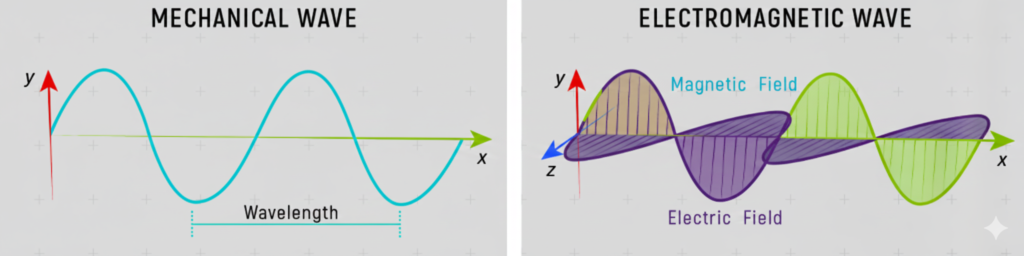
Mechanical and Electromagnetic waves work based on a medium that helps them travel.
The Magnetic ones are those that need a medium to travel. They cannot travel in a vacuum. The best examples of Mechanical waves are sound, water waves, rope, spring, and seismic waves.
The Electromagnetic one are those that do not need a medium. They can also travel in the vacuum. The best examples of electromagnetic are Gamma rays, X-rays, Ultraviolet, Visible light, Infrared, microwave, and radio waves.
General properties:
They are classified with these general properties:
- Displacement: Displacement is the distance of a particle on a wave from the mean position.
- Amplitude: Amplitude is the maximum displacement of a point on a wave from its mean position.
- Wavelength: Wavelength is the distance between two consecutive crests or troughs.
- Time period: The time period is said to be the time taken by one wave to complete an oscillation.
- Frequency: Frequency is the number of waves produced per unit time.
- Wavespeed: It is the distance travelled by one waveform in a unit of time.
- Wavefront: It is an imaginary line that is drawn by joining all the crests or troughs
Features of Waves:
Understanding the motion becomes easier once you know a few key terms. These terms describe how they behave and how we measure them
Crest & Trough:
- A crest (or peak) is the highest point a wave reaches above its rest or equilibrium position.
- A trough is the lowest point below the rest position.
- Together, crests and troughs show the up-and-down pattern of transverse waves.
Amplitude:
- Amplitude is the maximum displacement of a wave from its undisturbed (rest) position.
- It is measured from the rest line to either a crest or a trough.
- Symbol: A
- Unit: metres (m)
- A larger amplitude means more energy.
Wavelength
- Wavelength is the distance between two identical points on consecutive waves.
- In transverse waves, it can be measured from peak to peak.
- In longitudinal waves, it is measured from the centre of one compression to the next compression.
- Symbol: λ (lambda)
- Unit: metres (m)
- On wave diagrams, wavelength is usually shown along the x-axis.
Frequency:
- Frequency refers to the number of waves that pass a point in one second.
- Symbol: f
- Unit: Hertz (Hz)
Wave Speed:
- Wave speed describes how fast wave energy travels through a medium.
- Defined as the distance a wave travels per second.
- Symbol: v
- Unit: m/s
- Calculated using the formula:
v = f × λ
Wavefronts:
- Wavefronts are a top-down way of representing waves.
- Each wavefront represents a single wave.
- The direction the wave travels is often shown by a ray (arrow).
- The spacing between wavefronts indicates wavelength:
- Close wavefronts → shorter wavelength
- Spread wavefronts → longer wavelength
Reflection, Refraction, and Diffraction:
They do not just travel in straight lines; they interact with surfaces, boundaries, and obstacles. Three key behaviours are reflection, refraction, and diffraction, and these show up frequently in O-Level Physics exams.
- Reflection
Reflection occurs when a wave bounces off a surface or boundary and changes direction without changing medium.
Law of Reflection
Reflection obeys two rules:
- The angle of incidence equals the angle of reflection.
i = r - The incident ray, reflected ray, and normal all lie in the same plane.
This applies to both light (mirrors, shiny surfaces) and sound waves (echoes).
2. Refraction
Refraction is the bending of waves when they pass from one medium to another (e.g., air → water). It happens because the speed of the wave changes in different media.
Example:
A pencil in a glass of water appears “bent” because light slows as it enters water.
Refractive Index
The bending is measured using the refractive index:
n = sin i/sin r
where:
i = angle of incidence
r = angle of refraction
n = refractive index
Optical Density vs Speed
- A medium with higher optical density slows light more.
- When they enter a denser medium, they:
- bend towards the normal
- slow down
- decrease in wavelength
- When moving to a less dense medium, they:
- bend away from the normal
- speed up
- increase in wavelength
Important: Frequency remains constant during refraction.
Total Internal Reflection (TIR)
When light travels from a denser medium → less dense medium, it can be completely reflected instead of refracted. This occurs when the angle of incidence exceeds the critical angle.
Conditions for TIR
- Light must travel from a high refractive index to low.
- Angle of incidence > critical angle (c).
Relationship:
n = 1 / sin c
3. Diffraction
Diffraction is the spreading of waves when they pass through a gap or around an obstacle.
Key exam point:
Diffraction is most noticeable when:
gap size ≈ wavelength
Difference Between Mechanical and Non-Mechanical:
| Mechanical | Non-Mechanical |
| Require a medium (solid, liquid, or gas) to travel. | It does not require a medium and can travel through a vacuum. |
| Energy is transferred through the vibration of particles in the medium. | Energy is transferred by electromagnetic fields, without particle vibration. |
| Examples include sound, water, and seismic. | Electromagnetic (e.g., light, radio, X-rays) are non-mechanical. |
| Cannot travel in a vacuum because there are no particles to vibrate. | It can travel in a vacuum, which is why sunlight reaches Earth through space. |
Matter Waves (Wave-Particle Duality)
Matter waves can be confusing at first because they introduce the idea that matter behaves not only like a particle, but also like a wave. This idea comes from quantum physics, where scientists discovered that tiny particles such as electrons can show wave-like behaviour.
For example, a beam of electrons can be diffracted in a similar way to water waves or electromagnetic waves. This wave-like nature of matter was proposed by physicist Louis de Broglie and is known today as de Broglie’s Hypothesis.
Real-life application:
They are not just a physics concept; they are part of our everyday lives. From medical scans and wireless communication to music and scientific research, they play a major role in modern technology and society.
1. Medical Imaging
Certain types of waves are used to see inside the human body without surgery:
- Ultrasound: Uses high-frequency sound waves to form images of organs, tissues, and developing babies. It is safe and commonly used in hospitals.
- X-rays: Use electromagnetic waves with short wavelengths to view bones and dental structures. Their high energy allows them to penetrate soft tissue while being absorbed by denser materials like bone.
These techniques rely on wave reflection, absorption, and detection to create detailed images that doctors can interpret.
2. Communication Technology
Modern communication systems are built on electromagnetic waves of different wavelengths:
- Radio waves: Carry signals for radio broadcasts and television.
- WiFi: Uses microwaves to transmit data between devices and routers.
- 5G & Mobile Networks: Use higher frequency waves for faster data transfer and low-latency communication.
Because EM waves travel long distances and can carry information, they are essential for wireless technology, GPS, satellite communication, and the internet.
3. Entertainment & Media
Waves also shape how we experience movies, music, and digital content:
- Sound waves allow us to hear music, voice recordings, and audio in films.
- Light waves: Enable displays and screens on computers, TVs, and phones.
- Animation & Graphics: Use wave-like signals to control brightness, colour, and motion effects.
These applications show how both sound and light contribute to the entertainment industry.
Quick Summary:
To wrap up the revision notes, below is a quick recap, key definitions that you can skim at the time of revision, and the relevant formulas of this O-level physics topic:
Core Concepts
- They transfer energy, no matter.
- They can be mechanical (require a medium) or electromagnetic (travel through a vacuum).
- They are classified as transverse (oscillations perpendicular to travel direction) or longitudinal (oscillations parallel to travel direction).
- Sound is a longitudinal mechanical wave, while light is a transverse electromagnetic wave.
Key Definitions
- Crest: Highest point of transverse
- Trough: Lowest point of transverse
- Amplitude (A): Maximum displacement from the rest position
- Wavelength (λ): Distance between two identical points on consecutive waves
- Frequency (f): Number of waves passing a point per second
- Period (T): Time taken for one complete wave (T = 1/f)
- Wave Speed (v): Distance travelled by the wave per second
Formula Sheet:
- Wave Speed:
v = f × λ - Frequency:
f = 1/T - Refractive Index:
n = sin i/sin r - Critical Angle (TIR):
n = 1/sin c - Speed of Light in Vacuum:
c ≈ 3.0 × 10⁸ m/s
Learn O-Level Physics the Right Way:
At VACE Global, students learn O-Level Physics with an expert O-Level Physics teacher who simplifies challenging topics, builds strong exam techniques, and provides targeted past-paper practice. With personalised support and structured lessons, students gain the confidence they need to score higher grades. If you’re looking for an online physics tutor who can help you master the subject, Enroll Now or book a free academic consultation to get started.
FAQs:
- Is sound a longitudinal wave?
Yes. Sound travels as a longitudinal,which means particles in the medium vibrate parallel to the direction of wave travel. Sound also requires a medium (solid, liquid, or gas), so it cannot travel in vacuum.
- Why do waves slow down in denser media?
They slow down in denser media due to increased interaction between particles. In optical terms, denser media have a higher optical density, causing light to refract and change speed. Meanwhile, sound behaves differently: sound actually travels faster in denser solids because particles are more tightly packed.
- Which wave has the longest wavelength?
Within the electromagnetic spectrum, radio waves have the longest wavelength. They can range from meters to thousands of kilometres, which is why they are used for broadcasting, satellite communication, and navigation.
- Why do waves reflect?
Reflection occurs when they encounter a surface or boundary they cannot pass through. It bounces back at an angle equal to the angle of incidence. Reflection is seen in echoes (sound) and mirrors (light), and is a key principle in sonar, optical devices, and communication.