
After completing the O-levels, students are faced with a tough decision to choose the right pre-university qualification, IB vs A-levels. Choosing between the International Baccalaureate (IB) and A Levels isn’t just an academic decision; it’s a deeply personal one in your learning journey. When choosing a pre-university qualification, students often consider these two of the most well-recognized options. Both are hard and respected worldwide, but they differ in curriculum structure, assessment methods, and university recognition.
Since the students are in the final year of their secondary education, they find themselves in a tough situation and need to choose the right curriculum.
But how should a student in the UAE decide which one is the better one?
This blog by VACE Global will help the students analyze all the differences between the two qualifications and decide for themselves which one is better.
The Debate of IB vs A-levels:
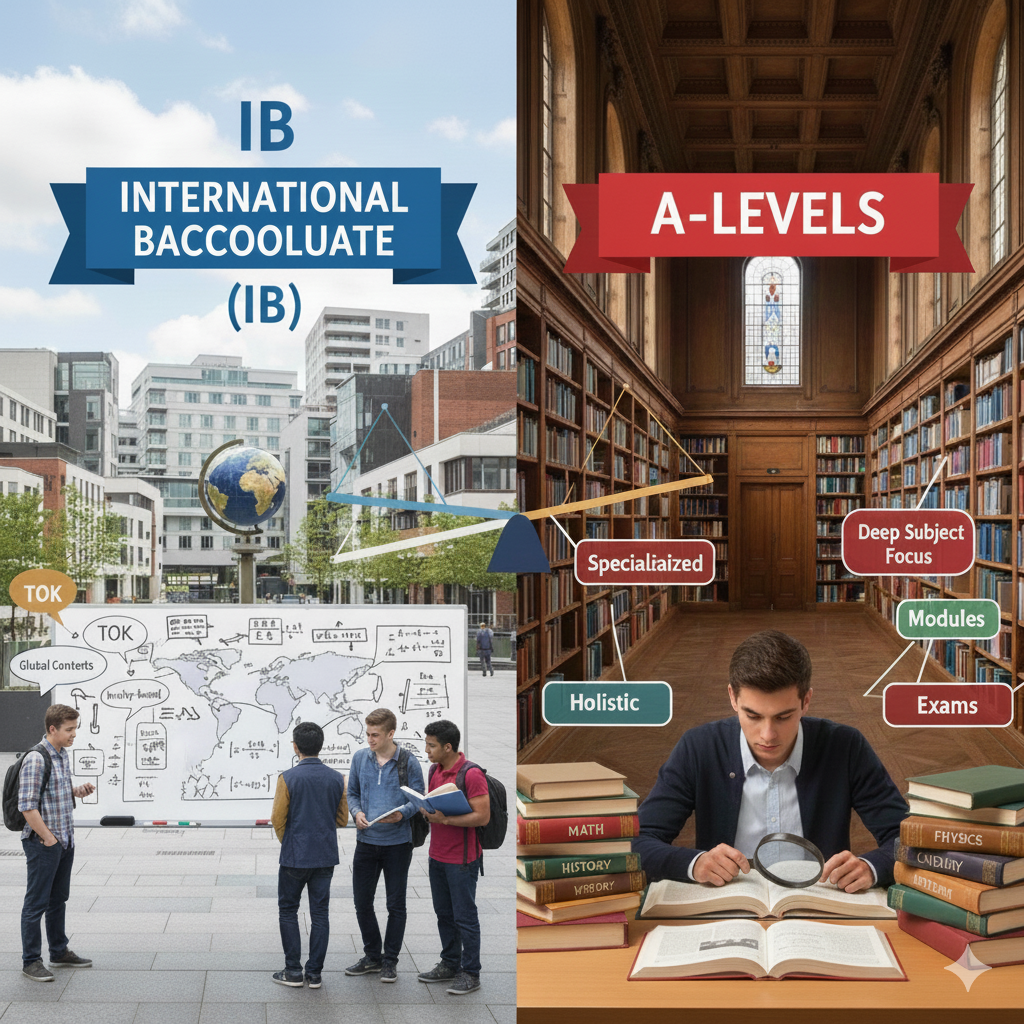
What are A-levels in the UAE?
The A-levels (Advanced Level qualification) are a UK-based academic program for students aged 16-18. It was founded 70 years ago and is the next step after GCSE or O-levels. A-levels are considered a standard qualification for students in the UK, Pakistan, England, and Northern Ireland. International universities in the UK, US, Canada, and Australia widely accept A-levels.
The students of A-levels have the free will and choice to select A-level subjects. They can build their own curriculum by balancing the difficult and easiest A-level subjects, keeping a mix for wider career opportunities. Each of the selected subjects is studied for a duration of 2 years, and then a final examination concludes them.
A-levels are considered beneficial for students who want to choose their own career and specifically go for a career in STEM.
What Is the International Baccalaureate (IB)?
The International Baccalaureate is a global qualification, created in 1968. It provides a broad level of education after two years of study. It is designed for the age group of 18-year-old students. IB is recognised by universities worldwide. It consists of six groups of subjects, which include science, arts, mathematics, and languages.
Ib incorporates additional subjects such as Theory of Knowledge (TOK), Creativity, Activity, Service (CAS), and Extended Essay.
These subjects are graded on a 1-7 scale, with 7 being the highest score. This makes the total score 45 points (7 subjects and three core).
IB vs A-levels: Key Differences at a Glance (Comparison Table)
| Feature | A-Levels | IB Diploma |
| Number of Subjects | 3–4 | 6 (3 Higher Level, 3 Standard Level) |
| Assessment Style | Mostly final exams | Exams + coursework + internal assessments |
| Grading System | A* – E | 1–7 per subject (Total: 45) |
| Independent Research Project | No | Yes (Extended Essay) |
| Extracurricular Requirement | No | Yes (CAS Program) |
Curriculum Structure: How Learning Works in Each System
A-Level Curriculum Structure:
The A-Level curriculum is designed for focused study in a few chosen subjects, usually three or four, over two years. Students delve deeply into each subject, developing specialised knowledge and skills. The structure emphasises independent learning, critical thinking, and exam preparation, with most of the final grade determined by end-of-course examinations. Some subjects may include coursework components, but the primary focus remains on mastering the chosen disciplines in depth. This approach is ideal for students who have a clear academic or career path and prefer concentrated study in areas of interest.
IB Curriculum Structure:
The IB Diploma Programme offers a broad and balanced curriculum across six subject groups: Language and Literature, Language Acquisition, Individuals and Societies, Sciences, Mathematics, and The Arts. Students choose a combination of Higher Level (HL) and Standard Level (SL) courses, with three HL and three SL subjects required for the full diploma. In addition to subject-specific learning, the IB incorporates core components such as the Extended Essay (EE), Theory of Knowledge (TOK), and Creativity, Activity, and Service (CAS), which foster research, critical thinking, and personal development. This structure encourages interdisciplinary learning and time management, making it suitable for students who thrive across a variety of subjects and enjoy a well-rounded education.
IB vs A-levels: Assessment & Exams
A-Level Assessment Pattern:
A Levels are subject-focused qualifications that rely mainly on end-of-course examinations. While a few subjects include coursework components, the majority of a student’s final grade is determined by performance in high-stakes exams taken at the end of the two-year programme.
IB Assessment Pattern:
The IB assessment system blends internal and external evaluations. External assessments consist of written examinations conducted at the end of the two-year programme, while internal assessments include coursework, oral presentations, and research-based projects. Students are graded on a scale from 1 to 7, with the system emphasising academic breadth and interdisciplinary learning.
Subject Flexibility:
Subject Choice in A-Levels:
A Levels offer a wide range of around 55 subjects, covering areas such as English, mathematics, sciences, languages, humanities, technology, social sciences, arts, and general studies. This flexibility allows students to choose subjects aligned with their interests and academic goals, though availability may differ by school. The curriculum also places strong emphasis on independent study, giving students greater freedom in managing their time and learning pace.
Allows students to specialise deeply in chosen subjects, encouraging focused learning in areas they are genuinely passionate about.
Subject Choice in IB:
In the two-year IB Diploma Programme, students study six subjects selected from six subject groups: Language and Literature, Language Acquisition, Individuals and Societies, Sciences, Mathematics, and the Arts.
Students choose a mix of Higher Level (HL) and Standard Level (SL) courses, with HL subjects offering greater depth and broader content coverage. To earn the full IB Diploma, students must complete three HL and three SL subjects. The IB also provides non-standard diploma options to support specific academic or career pathways, such as medicine in India, which may require students to take three science subjects alongside mathematics.
Workload & Stress Levels:
A-Levels:
A Levels are ideal for students who prefer to focus deeply on a few subjects rather than spreading their attention across many. With fewer subjects, students can manage their workload more effectively, reduce overall stress, and dedicate time to mastering topics in depth. Those who excel with independent study and structured revision tend to thrive in the A-Level system. Emphasises a smaller number of subjects, which can lower overall workload but demands greater intensity and focus in each chosen area.
IB:
The IB Diploma suits students who enjoy a balanced workload and are comfortable handling multiple subjects across various disciplines. With a mix of exams, coursework, and the Extended Essay, IB students develop strong time management and multitasking skills. Those who thrive under consistent work pressure, enjoy interdisciplinary learning, and actively participate in extracurricular activities typically excel in the IB programme.
University Recognition: UAE & International Admissions
A-Levels for University:
Widely recognised by UK universities and higher education institutions worldwide, and often preferred for admission to UK-based programmes.
IB for University:
Globally recognised and considered particularly beneficial for students applying to universities across multiple countries.
Cost Comparison in the UAE
A-Level Cost Factors:
A-Level costs in the UAE generally depend on tuition fees, which may be charged per subject or as a flat programme fee, as well as exam fees from boards like Cambridge or Edexcel. Additional expenses include textbooks, study materials, and optional extra coaching or tutoring. Since students typically focus on three or four subjects, A-Levels can be relatively more cost-effective, with fewer exam fees and study resources required.
IB Cost Factors:
The IB Diploma tends to involve higher costs due to its broader curriculum. Tuition fees usually cover the full two-year programme, while exam fees include assessments for six subjects plus core components such as the Extended Essay and Theory of Knowledge. Additional costs may arise from textbooks and study materials across all six subjects, as well as participation in Creativity, Activity, and Service (CAS) activities or school-organised projects. Although more expensive, the IB reflects a globally recognised, holistic education that develops a wide range of skills.
Learning Style:
A-Level:
Well-suited for students who prefer focused learning and in-depth mastery of a smaller number of subjects.
IB:
More suitable for students who prefer a balanced workload and are comfortable managing multiple subjects across different disciplines.
The Scope of IB vs A-levels:
A-level:
A Levels allow students to specialise in three or four subjects over two years, promoting in-depth understanding and expertise. This focused approach is ideal for those with a clear career goal or intended university course, as it provides a strong foundation and demonstrates commitment to their chosen field.
IB:
The IB Diploma offers a more holistic approach to pre-university education, with students studying six subjects spanning humanities, sciences, languages, mathematics, and the arts. Combined with the Theory of Knowledge (TOK), Extended Essay (EE), and Creativity, Activity, and Service (CAS) components, the programme nurtures critical thinking, global awareness, and interdisciplinary skills. It is particularly well-suited for students who enjoy and excel across a broad range of subjects.
Pros and Cons of A-Levels
Pros:
- Specialization: Students can focus on subjects they excel in, making A-Levels ideal for those with clear career or university goals.
- Flexible Choice: Learners are not required to study subjects outside their chosen areas, allowing for concentrated expertise.
- Widely Accepted: A-Levels are highly regarded, particularly in the UK, and recognised by universities and institutions worldwide.
Cons:
- Limited Scope: The narrow focus may limit exposure to a broader, interdisciplinary education.
- Exam-Based System: Heavy reliance on final exams can create pressure and may not suit every learning style.
- Less Focus on Research: Compared to the IB, A-Levels offer fewer opportunities for independent research and inquiry.
Pros and Cons of the International Baccalaureate (IB)
Pros:
- Broad Education: The IB covers a wide range of subjects, promoting well-rounded academic development.
- Critical Thinking: Components like Theory of Knowledge (TOK) and the Extended Essay (EE) enhance research, analysis, and problem-solving skills.
- Global Recognition: Universities worldwide highly value the IB for its challenging and comprehensive curriculum.
- Balanced Skill Development: The Creativity, Activity, Service (CAS) programme supports personal growth through extracurricular and community involvement.
Cons:
- Heavy Workload: The extensive curriculum demands strong time management and organisational skills.
- Limited Specialization: Students cannot focus exclusively on preferred subjects, which may be a drawback for those with specific career goals.
- Complex Assessment System: The combination of internal assessments, coursework, and final exams can be challenging to manage.
Which is More Valued by Universities: A-Levels or IB?
Both A-Levels and the IB Diploma are highly respected by universities worldwide, but preferences often depend on the institution, country, and specific course requirements.
- UK Universities: A-Levels remain the standard qualification for admission, though IB students are also welcomed.
- US and European Universities: The IB is sometimes preferred due to its broad curriculum, research-focused components, and emphasis on independent learning.
- STEM vs. Humanities: A-Levels are often ideal for STEM subjects, allowing students to concentrate on math and science. Meanwhile, the IB’s balanced and interdisciplinary approach suits humanities and courses that benefit from a wider academic perspective.
Which Is Better in the UAE: IB vs A-levels?
Choosing between A-Levels vs IB Diploma in the UAE depends on a student’s learning style, academic goals, and career aspirations.
A-Levels are ideal for those who prefer to specialise in a few subjects and aim for focused mastery, especially in STEM fields.
The IB is better suited for students who enjoy a broader curriculum, want to develop interdisciplinary skills, and can manage a heavier workload that includes coursework, exams, and extracurricular requirements.
Ultimately, the “better” choice varies from student to student.
How to Decide: A Practical Checklist for Parents & Students
- Career Goals: Are your aspirations specialised (STEM) or broad/interdisciplinary?
- Learning Style: Do you prefer in-depth focus (A-Levels) or a balanced workload across multiple subjects (IB)?
- Workload Management: Can the student handle extended essays, internal assessments, and extracurricular commitments?
- University Recognition: Check target universities’ preferences and entry requirements.
- School Availability & Costs: Consider tuition fees, exam fees, and resources available locally in the UAE
How VACE Global Supports A-Level Students in the UAE:
VACE Global provides expert faculty for students in the UAE, delivering personalised online tutoring that helps learners build strong conceptual foundations and excel in high-stakes exams. Our programmes are designed to support students in their chosen subjects while effectively managing their workload. With access to past papers, study resources, and flexible online classes, students are fully equipped to achieve academic success.
In addition, VACE Global offers guidance on scholarships offered to help families navigate the challenges of rising tuition fees in the UAE, making world-class education more accessible.
Take the first step toward academic excellence, enroll today, and empower your child with the skills and support they need to thrive in A-Level or IB studies.
FAQs:
Q1: Which is easier for UAE students, A-Levels or IB?
A1: “Easier” depends on the student. A-Levels are focused and exam-based, while IB requires managing six subjects plus extended essays and CAS activities.
Q2: Can IB students specialise in subjects like STEM?
A2: While the IB offers depth through Higher Level subjects, it is less specialised than A-Levels for STEM-focused study.
Q3: Are A-Levels recognised internationally?
A3: Yes, A-Levels are widely accepted by universities globally, particularly in the UK and Commonwealth countries.
Q4: Which programme is more expensive in the UAE?
A4: IB generally has higher tuition and additional costs due to its broader curriculum and core components, while A-Levels can be more cost-effective for students taking fewer subjects.
Q5: Can VACE Global help with IB students too?
A5: Currently, VACE Global specialises in A-Level tutoring for UAE students, providing expert guidance in selected subjects to maximise results.