
The vast range of A-level subjects offered to students is categorized into either the easiest A-level subjects or the difficult ones. A-level sociology lies between these two extremes. A-level sociology is purely a theoretical subject, and its difficulty level depends on interest and students’ capability to learn.
Introduction to A-level sociology:

A-level sociology is a social science subject. It teaches students about society, human behavior, and social institutions like family, education, and media. This subject is backed by social theories and research methods that help understand social change, inequalities, and social issues.
This subject unfolds how society functions, how students interact, and the structures that shape our society. It covers big questions such as: What influences human behavior? How do culture, family, education, and media impact society?
Unlike A-level physics, sociology doesn’t have any practical testing. For many students, an introduction to Sociology A-level is their first step into the world of social sciences, opening doors to careers in law, teaching, social research, politics, and more.
Boards that offer A-level sociology:
A-level sociology is offered by different boards. More or less, the syllabus offered by these educational boards is the same and with a little bit of variation. The Edexcel or Cambridge, AQA, and OCR are the boards that offer A-level sociology widely. Before understanding the difference between the A-level sociology syllabi of different boards, we should know what we actually study in sociology.
What do you study in A-level sociology?
The A-level sociology offers a mix of different topics that vary according to your examination board. The major areas that sociology covers are:
- Social Stratification and Inequality: This topic examines how society is divided by class, gender, ethnicity, and age, and how these inequalities impact people’s opportunities and life chances.
- Education: You study the role of education in society, including achievement gaps, school policies, and how education reinforces or challenges social inequality.
- Crime and Deviance: This area explores why people commit crimes, how deviance is defined, and how society responds to crime through laws, policing, and punishment.
- Family, household, and other social institutions: This focuses on the changing role of the family and other institutions like religion, media, and economy, analyzing their influence on social life and relationships.
These topics are the foundational pillars of sociology. Based on these topics, sociology introduces sociological theories that shape and unfold reasons and factors that lead to why society behaves a certain way.
Theories of Sociology:
In the A-level sociology qualification, regardless of the education board, you will study major sociological theories:
- Functionalism:
Functionalism views society as a system made up of interdependent parts, like a living organism. Each institution (family, education, religion, economy) has a role that contributes to the stability and smooth functioning of society. Functionalists such as Émile Durkheim and Talcott Parsons argue that shared values and norms create social order. Critics, however, say functionalism ignores inequality and conflict.
- Marxism:
Marxism, based on the ideas of Karl Marx, focuses on inequality and conflict in society, especially between social classes. It argues that the bourgeoisie (owners of wealth) exploit the proletariat (working class), leading to class conflict. Marxists believe social institutions like education, media, and law serve the interests of the ruling class by maintaining capitalism. They emphasize change through revolution and social transformation.
- Feminism:
Feminism highlights gender inequality in society. It argues that institutions such as family, workplace, and education reinforce patriarchy (male dominance). Different strands exist: Liberal feminism calls for equal opportunities and gradual reform. Radical feminism sees patriarchy as deeply entrenched and calls for radical change. Marxist feminism links women’s oppression to capitalism and class exploitation. Overall, feminists aim to achieve gender equality and challenge sexist practices in society.
- Interactionism:
Interactionism (or symbolic interactionism) focuses on micro-level social interactions rather than large-scale structures. It studies how people create meaning through everyday interactions, symbols, and language. For example, labels given by teachers can shape a student’s identity and academic performance. Thinkers like George Herbert Mead and Howard Becker emphasize that reality is socially constructed.
- The new right:
The New Right is a conservative sociological and political perspective that emerged in the late 20th century. It emphasizes individual responsibility, traditional family values, and limited government intervention. In sociology, the New Right is critical of welfare dependency, single-parent families, and what it sees as the decline of traditional institutions. It shares some similarities with functionalism in stressing the importance of social order, but with a stronger political edge.
Sociologists discovered these theories after careful observation and research. The sociology of A-levels also provides a glimpse into the research methodologies used to develop theories. The research methods used by the sociologists include: interviews, surveys, official statistics, observations, and experiments.
This subject lets you evaluate the strengths and weaknesses of these research methodologies and teaches you how evidence and data are collected.
The paper pattern of the sociology A-level
A-level sociology, being a theoretical subject, is assessed through written exams. The assessment pattern is slightly different for each board.
- The Cambridge A-level sociology exam consists of 4 papers. Each of them is a written exam that tests different topics and theories. One paper out of the 4 is an essay.
- The AQA assesses sociology through three written exams. Consisting of short and long question answers.
- OCR uses a component-based system. Papers are of varying length and marks, including short-answer and longer, more analytical questions.
- The Edexcel exam is on the same pattern as the other boards.
Collectively, A-level sociology consists of three to four written exams with no coursework. Strong essay writing is essential to score a good grade.
Preparation material for sociology:
To prepare and score good in A-level sociology, you need to have accurate resources. Resources you need to prepare for sociology are:
- Sociology A-level syllabus:
The Sociology A-level syllabus outlines the core topics and skills you need to master for the exam. It typically includes areas such as education, family and households, media, crime and deviance, and research methods. Each exam board—Cambridge, AQA, OCR, and Edexcel—offers slightly different content and optional modules, so it’s important to check the official A-level Sociology syllabus PDF for your board. Understanding the syllabus early helps you plan your study schedule, focus on compulsory topics, and choose optional ones that match your strengths.
- Sociology A-level past papers:
Practicing with sociology A-level past papers is one of the most effective ways to prepare for exams. Past papers allow you to:
- Familiarize yourself with the exam format and question styles.
- Improve time management under timed conditions.
- Identify recurring themes and key topics.
- Learn how to apply sociological theories to real-life examples.
Most exam boards provide free access to past papers and mark schemes on their websites, making them a must-have revision tool.
- Sociology A-level notes:
Well-organized sociology A-level notes are essential for revision. Notes help you summarize complex theories, highlight important case studies, and structure arguments for essay-style questions. Students can create their own notes from textbooks, lectures, and class discussions, or use reliable study resources available online. The best approach is to:
- Break notes down by topic (Education, Family, Crime, Media, etc.).
- Include key theorists (Durkheim, Marx, Weber, Becker, etc.) with short explanations.
- Use diagrams, mind maps, and tables for quick recall
Strong notes save time before exams and improve retention.
- Sociology A-level book:
Choosing the right sociology A-level book is crucial for exam success. Recommended textbooks vary by exam board, but some widely used ones include:
- Sociology for AQA A-level by Ken Browne.
- Cambridge International AS & A Level Sociology by Chris Livesey.
- AQA A-level Sociology Book 1 & 2 by Rob Webb and Hal Westergaard.
These books cover the syllabus comprehensively, provide exam-style practice questions, and explain sociological theories in a student-friendly way. Supplementing your main textbook with revision guides and academic articles can further strengthen your understanding.
Understanding the A-level sociology threshold?
The A-level sociology threshold or grade boundaries refer to how students are marked on their A-level sociology exam. The Cambridge Sociology threshold PDF is available online. These threshold changes yearly by the reputable owners of the examination board.
The image below clearly tells the threshold:
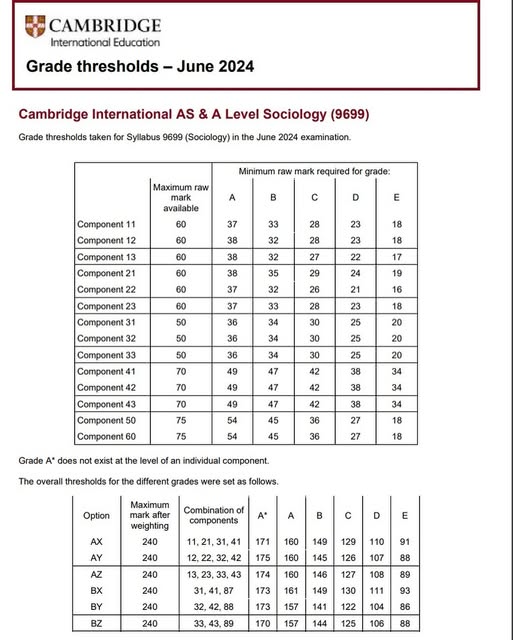
This image shows the Cambridge threshold. Other examination boards have their respective marking and grading systems.
Difference between sociology and psychology A-level:
Most students confuse sociology with the psychology of A-levels. There is a difference between the subjects, though some concepts might intersect. While sociology studies society, institutions, and groups, which represent macro perspectives, psychology studies the human mind and behavior, focusing on the micro perspective. Psychology also examines concepts such as the psychological well-being of students.
Tips for scoring high in sociology:
Students can score high in sociology by following these tips:
- Study with an effective study schedule: Plan your revision with a clear timetable that balances theory, case studies, and essay practice. Sticking to a study schedule helps you cover the full syllabus without last-minute stress.
- Use past papers: Practicing past papers gives you insight into exam trends and common question types. It also helps build confidence and improve exam technique.
- Incorporate the marking scheme and examiner report: Don’t just attempt past papers, review marking schemes and examiner reports to understand what examiners are looking for. This helps you avoid common mistakes and gain more marks.
- Write essays with evaluation: Strong essays go beyond describing theories by critically evaluating them. Always weigh strengths and weaknesses to show depth of understanding.
- Support arguments with real-world examples: Linking sociological theories to real-life examples strengthens your answers. It shows examiners that you can apply abstract concepts to practical situations.
- Learn key names of sociologists and their studies: Remembering important sociologists and their research is essential. Quoting studies adds credibility and demonstrates a strong grasp of the subject.
- Practice time management during exams: Allocate time wisely across all questions to maximize marks. If you get stuck, move on and return later instead of losing valuable time. Practicing time management is important to score well.
How to revise Sociology A-level?
Effective revision is essential to get an A grade, not just for A-level sociology but O-level subjects as well. Here are some proven strategies to revise Sociology A-level:
- Use active recall: Instead of passively re-reading notes, test yourself regularly on key terms, theories, and case studies. This strengthens memory and improves exam retention.
- Make mind maps: Mind maps are a great way to connect sociological theories, thinkers, and examples. They give you a quick visual overview, making revision more engaging and effective.
- Practice essays: Essay writing is central to Sociology exams. Practicing essays helps you structure arguments, integrate evaluation, and improve clarity under timed conditions.
- Practice with past papers: Working through past papers familiarizes you with exam styles and recurring topics. It also helps you refine time management and exam technique.
- Revise with other classmates: Group study allows you to share perspectives and test each other’s knowledge. Discussing theories with peers can also deepen your understanding of complex topics.
Learn sociology with VACE Global:
A-level Sociology is a subject that challenges your thinking and expands your understanding of the world. With the right notes, books, past papers, and revision strategies, you can approach exams with confidence.
At VACE Global, we provide expert A-level tutors, updated resources, and structured learning plans to help students achieve top grades. Whether you need support in Sociology, Psychology, or other A-level subjects, our team is here to guide you. Explore our merit-based scholarships, expert faculty, and short courses to get started, enroll now, and take your preparation to the next level.
FAQs:
Q1: What topics are covered in A-level Sociology?
A-level Sociology covers education, family, media, crime, and research methods. Some boards also include religion and theory.
Q2: Which is better: A-level Sociology or Psychology?
It depends on your interests. Sociology focuses on society and institutions, while Psychology focuses on individuals and behavior.
Q3: How hard is A-level Sociology?
Sociology is considered moderately challenging. Success depends on essay-writing skills, critical thinking, and thorough revision.
Q4: Where can I download the A-level Sociology syllabus PDF?
You can download it from the official websites of Cambridge International, AQA, or Edexcel.
Q5: What’s the best way to revise A-level Sociology?
Combine notes, past papers, and active recall. Writing timed essays and reviewing mark schemes is especially effective.