
Pakistan Studies is a mandatory O-level subject. Every O-level student has to appear for this subject in the first year of O-levels. Students, as usual, study it throughout the year and appear in the O-level exam, but do not know why they have to study Pakistan studies. They are unaware of the importance of Pakistan studies as a subject.
Whether you are a student of Edexcel or Cambridge, Pakistan studies is mandatory for both.
This blog will help you understand the importance of Pakistan studies as a subject and what it teaches us.
To explore more about O-level and A-level subjects, stay tuned with VACE Global and get the latest updates
Table of Content
Why is Pakistan Studies an Important subject?
When was Pakistan studies introduced as a subject?
The importance of studying Pakistan studies:
How does this subject help in understanding the origin of Pakistan?
Can I know the development and creation of Pakistan through this subject?
How to Prepare for the Pakistan Studies O-Level Syllabus Effectively?
Which boards offer this as a mandatory subject?
O-level Pakistan studies exam pattern
Where can I find expert O-level Pakistan studies teachers?
Key Takeaway:
- Pakistan Studies combines History and Geography to help students understand Pakistan’s origin, development, and physical features.
- Introduced in the 1970s, it promotes patriotism, national awareness, and responsible citizenship.
- The subject develops civic awareness, critical thinking, and analytical skills.
- It explains Pakistan’s creation, the Two-Nation Theory, and post-independence development.
- O-Level preparation tips: review syllabus, use reliable resources, practise past papers, manage time, and seek expert guidance.
- Exam pattern: two papers, History & Culture, and Environment of Pakistan.
- VACE Global offers expert teachers, an advanced LMS, and regular past paper practice for effective preparation.
What is Pakistan Studies?
Pakistan studies is one of the mandatory subjects in the first year of O-levels. Pakistan studies is a combination of two different aspects of these studies, Geography and History.
Geography is the study of the land, its physical features, rivers, deserts, climate, and other features such as dams.
History teaches of the origin and creation of Pakistan. The leaders and the people who contributed to the independence of Pakistan.
Together, Geography and History combine to make Pakistan studies a complete subject.
When was Pakistan studies introduced as a subject?
Pakistan Studies was made a compulsory subject alongside Islamiat at the secondary and higher secondary levels during the Bhutto era in the 1970s. The purpose of introducing it as a distinct mandatory subject was to foster patriotism among young people and promote awareness of Pakistan’s ideology. It also aimed to prepare students to become informed, responsible, and active citizens of the country.
Why do I have to study it?
Many students often wonder why Pakistan Studies is a compulsory subject in school. At first glance, it may seem like a subject focused only on memorising dates, events, and political facts. However, Pakistan Studies plays a far more important role in shaping students’ understanding of their country, identity, and responsibilities as citizens.
Studying Pakistan Studies helps students understand how and why Pakistan came into existence, the struggles behind its independence, and the vision of its founders. This knowledge builds a sense of national identity and allows students to appreciate the sacrifices made for the country’s freedom. Without this historical awareness, it becomes difficult to truly value the nation we live in today.
The subject also develops civic awareness. It introduces students to Pakistan’s constitution, political system, geography, economy, and social structure. By learning these aspects, students gain a clearer understanding of how the state functions and how citizens can contribute positively to society. This is essential for developing informed, responsible, and law-abiding individuals.
In addition, Pakistan Studies encourages critical thinking and analytical skills. Rather than just learning facts, students are expected to analyse historical events, evaluate policies, and understand their impact on Pakistan’s present and future. These skills are valuable not only in exams but also in real-life decision-making.
Most importantly, Pakistan Studies promotes unity, tolerance, and national cohesion. It highlights the diversity of cultures, languages, and regions within Pakistan while emphasising shared values and national goals. This helps students develop respect for different communities and a stronger sense of collective responsibility toward the country.
In short, Pakistan Studies is not just an academic requirement; it is a subject that helps students understand their roots, their rights and duties, and their role in building a better future for Pakistan.
The importance of studying Pakistan studies:
Pakistan Studies is a vital subject that helps students understand the historical, ideological, political, and cultural foundations of the country. Its importance goes far beyond exam preparation; it plays a key role in shaping informed, responsible, and aware citizens who understand their national identity and civic duties.
- One of the main reasons it is important is that it connects students with the country’s history and ideology. By learning about the struggle for independence, the Two-Nation Theory, and the vision of Quaid-e-Azam Muhammad Ali Jinnah, students gain a deeper appreciation of why Pakistan was created and the principles on which it was founded. This historical awareness strengthens national identity and a sense of belonging.
- The subject also promotes civic responsibility and political awareness. It introduces students to the constitution, system of governance, fundamental rights, and responsibilities of citizens. This knowledge empowers young people to participate thoughtfully in society, make informed decisions, and contribute positively to the democratic process.
- Another important aspect is its role in developing critical thinking and analytical skills. Students are encouraged to analyse historical events, evaluate political developments, and understand socio-economic challenges faced by Pakistan. These skills help learners move beyond rote memorisation and develop a balanced, thoughtful perspective on national and global issues.
- It also highlight the country’s geographical diversity and natural resources, helping students understand how geography influences climate, agriculture, economy, and regional development. This awareness is essential for understanding current environmental and economic challenges and the need for sustainable development.
- Moreover, the subject fosters national unity, tolerance, and social harmony. By learning about Pakistan’s diverse cultures, languages, and regions, students develop respect for diversity while recognising the shared values that unite the nation. This understanding is crucial for promoting peace, inclusivity, and national cohesion.
- In essence, studying Pakistan Studies equips students with the knowledge, values, and skills needed to understand their country and play an active role in its progress. It prepares learners not only to succeed academically but also to become conscious, responsible citizens committed to Pakistan’s future.
How does this subject help in understanding the origin of Pakistan?
Pakistan Studies as an academic subject examines the political, economic, and social circumstances that emerged after the War of Independence in 1857, which led Indian Muslims to view themselves as a distinct nation separate from Hindus.
In simpler terms, it helps explain the key factors that gave rise to the Two-Nation Theory by addressing questions such as: What motivated Muslims to demand a separate homeland?
Can I know the development and creation of Pakistan through this subject?
Yes, it allows you to understand both the creation and development of Pakistan in a structured and comprehensive way. As an academic subject, it explores the historical process that led to the establishment of Pakistan, as well as the progress and reforms that followed independence across different areas of national life.
Through this, students examine key political, constitutional, and institutional developments that shaped the country after 1947. The subject also explains how past experiences, available resources, and national challenges influenced policy decisions and development planning. In this way, Pakistan Studies not only explains how Pakistan came into being but also how it has evolved and continues to move forward.
How to Prepare for the Pakistan Studies O-Level Syllabus Effectively?
Preparing for O-Level Pakistan Studies requires a clear strategy, a strong understanding, and regular practice. Follow these key steps to study effectively:
- Review the syllabus thoroughly: Understand assessment objectives, key themes, and paper weightage to prioritise important topics like the creation of Pakistan, constitutional developments, and contemporary issues.
- Use reliable study materials: Build a strong foundation with recommended textbooks and notes, focusing on understanding causes, effects, and significance rather than rote memorisation.
- Practise past papers regularly: Pay attention to command words such as describe, explain, and assess, and learn to structure answers according to Cambridge marking schemes.
- Manage your time: Practise writing answers within exam time limits and present them in a clear, organised manner.
- Seek expert guidance: Learn from experienced teachers to clarify complex topics, receive feedback, and improve exam technique.
Which boards offer this as a mandatory subject?
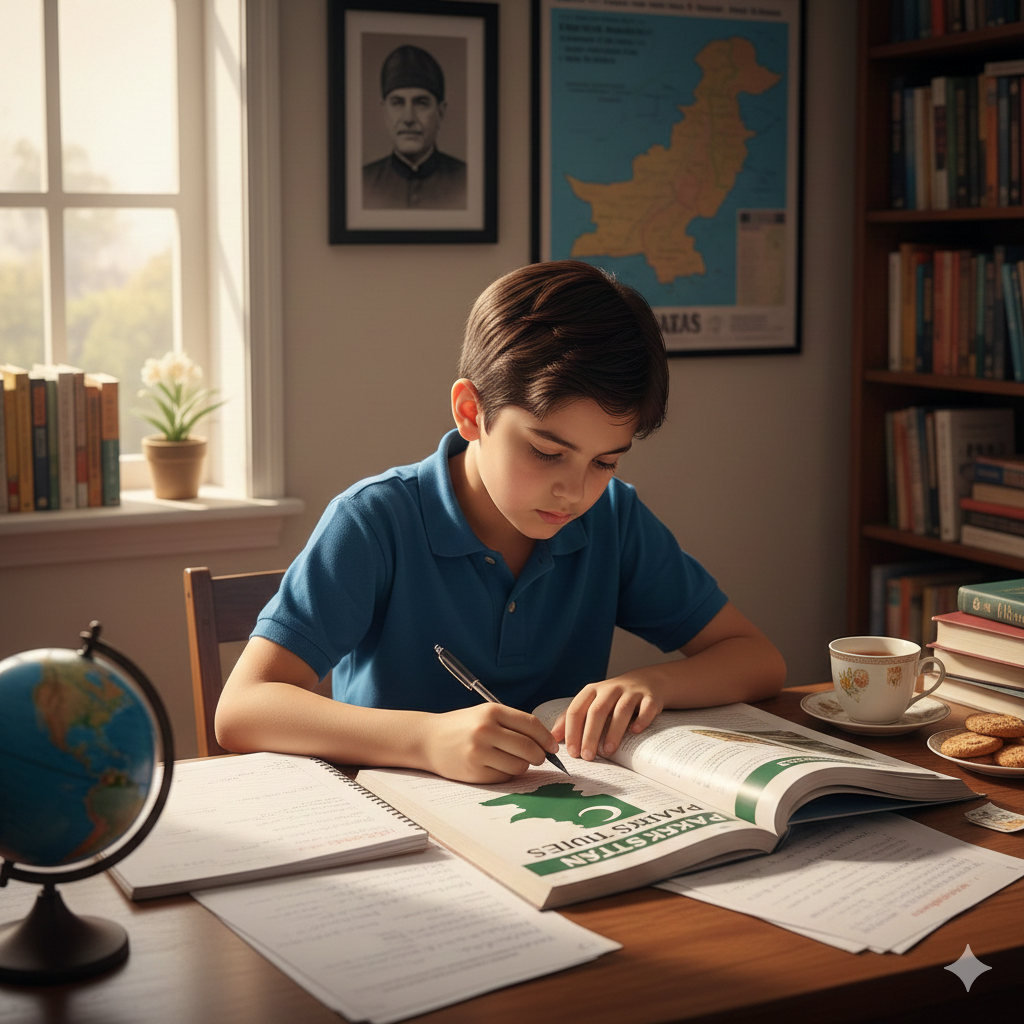
It is a mandatory subject for Pakistani students under several examination boards. The Cambridge International Education (CIE) requires O-Level students of Pakistani nationality to appear in Pakistan Studies. Similarly, local boards such as the FBISE and provincial BISE boards include Pakistan Studies as a compulsory subject at secondary and higher secondary levels, whether students opt for an international route, such as A-level vs FSc, or follow the local education system.
This requirement ensures that students develop a strong understanding of Pakistan’s history, ideology, and national development, regardless of the academic pathway they choose.
O-level Pakistan studies exam pattern:
The O-Level Pakistan Studies examination conducted by CAIE consists of two papers:
- Paper 1: History and Culture of Pakistan
- Paper 2: Environment of Pakistan
Each paper is typically 1 hour and 30 minutes long and includes structured questions that test knowledge, understanding, and analytical skills. Questions may require students to describe events, explain causes and consequences, interpret data, and evaluate historical or environmental issues.
Marks are awarded not only for factual accuracy but also for clear explanation, logical structure, and relevant examples, making exam technique just as important as content knowledge.
Where can I find expert O-level Pakistan studies teachers?
Finding the right teacher is essential for achieving high grades in O-Level Pakistan Studies, and this is where VACE Global stands out. At VACE Global, students are taught by experienced CAIE-trained teachers who specialise in simplifying complex historical concepts, refining answer structures, and teaching students how to score effectively using Cambridge mark schemes. Students are taught how to answer questions, especially 6-mark geography questions.
VACE Global offers a complete, exam-focused learning experience for students. Learners are guided by an expert Pakistan Studies teacher with strong CAIE experience, ensuring clear conceptual understanding and effective exam techniques. Students also benefit from an advanced Learning Management System (LMS) that provides easy access to class recordings, organised study materials, and structured progress tracking. In addition, regular past paper practice is built into the programme, helping students master Cambridge-style questions and improve time management and answer quality.
Conclusion:
Pakistan Studies is a compulsory yet highly meaningful subject that helps O-Level students understand the creation, development, and challenges of Pakistan. With the right preparation strategy, quality resources, and expert teacher support, students can not only score well in exams but also develop a deeper understanding of their country’s history and identity. Consistent effort, conceptual clarity, and exam-focused practice are the keys to success.
FAQs:
- Is it compulsory for all O-Level students?
Pakistan Studies is compulsory for students of Pakistani nationality under the CAIE O-Level system.
2. How many papers are there in O-Level Pakistan Studies?
There are two papers: one focusing on History and Culture, and the other on the Environment of Pakistan.
3. Is memorisation enough to score well in Pakistan Studies?
No. While factual knowledge is important, understanding concepts, analysing causes and effects, and writing structured answers are essential for high grades.
4. How can I improve my answer-writing skills?
Regular past paper practice, understanding command words, and getting feedback from experienced teachers can significantly improve answer quality.
5. Can I prepare for O-Level Pakistan Studies online?
Yes. Many reputable platforms, including VACE Global, offer online classes with expert teachers and exam-focused preparation.