
With the increasing awareness and educational systems, the educational sector is becoming vast and diverse. The student body explores and examines different curricula, exploring the benefits and career opportunities they bring. One such curriculum, different from Edexcel vs Cambridge, is the American curriculum.
The American Curriculum is one of the most widely recognized education systems in the world, known for its flexibility, creativity, and student-centered approach. Unlike other systems that rely heavily on memorization, the American Curriculum emphasizes critical thinking, problem-solving, and real-world application. It’s a system designed to help students grow academically, socially, and emotionally. It takes into consideration the psychological well-being of students while educating them.
In this comprehensive blog, we’ll explore everything about the American Curriculum, its structure, grading system, subjects, benefits, and how it compares to other curricula such as British (IGCSE/A Level) and IB. Whether you’re a parent choosing the right school for your child or a student preparing for higher education, this guide will help you understand the value of the American education system.
What is the American Curriculum in Schools?

The American Curriculum is an educational framework developed in the United States that focuses on a holistic approach to learning. It’s not governed by one centralized authority; instead, it is designed and monitored by state education departments and regional accreditation bodies across the U.S.
This system encourages students to be active learners, exploring, questioning, and applying knowledge rather than simply memorizing facts. The ultimate goal is to help students become well-rounded individuals prepared for higher education and global careers.
American curriculum key features:
The American Curriculum stands out because of its flexibility and continuous learning approach. Here are some of its defining features:
- Continuous Assessment: Students are evaluated throughout the year through quizzes, projects, and participation rather than relying solely on final exams.
- Broad Subject Choice: Students can explore various subjects and later specialize based on their interests.
- Emphasis on Core Subjects: The American curriculum emphasizes learning core subjects, building the foundation for future learning.
- Emphasis on Extracurriculars: Sports, arts, leadership programs, and community service are essential parts of the learning experience.
- Individualized Learning: Students can select electives and pace their education according to their learning style.
- Credit-Based Promotion: Progression is based on accumulated credits rather than fixed national exams.
The American Curriculum Syllabus:
The American curriculum syllabus is a set of guidelines for the schools that follow this curriculum. This syllabus emphasizes the core subjects such as English, Mathematics, Science, and Social Studies. It is structured by grade level (pre-Kindergarten through 12th grade), with a typical high school diploma awarded upon completion of required credits. The syllabus includes core subjects plus electives in arts, languages, and physical education, and often has a two-semester academic year.
Most schools that follow this curriculum divide the academic year into two semesters, with the first running from August to December and the second from January to June.
The educational structure:
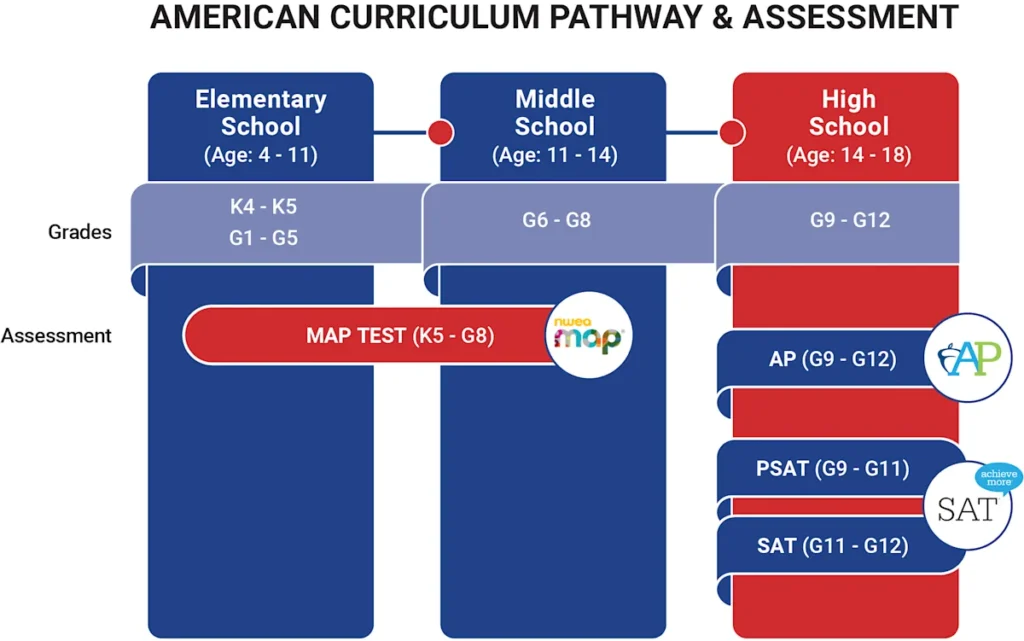
The educational structure of the American Curriculum is divided into three main stages, each tailored to specific developmental and academic needs.
1. Elementary School (Grades K–5)
- Focuses on building core literacy and numeracy skills.
- Subjects: English, Math, Science, Social Studies, and introductory Arts.
- Teachers emphasize curiosity, collaboration, and foundational thinking skills.
2. Middle School (Grades 6–8)
- Students are introduced to a broader curriculum, including technology, foreign languages, and social sciences.
- Focus on developing independent learning and research skills.
- Character development and leadership programs are also introduced.
3. High School (Grades 9–12)
- Students choose core subjects and electives aligned with their college or career goals.
- Opportunities to take Advanced Placement (AP) or Honors courses for college credit.
- Guidance counseling helps students plan university applications and standardized tests like the SAT or ACT.
The subjects offered:
The American curriculum ensures a balance between academic and creative learning through a mix of core subjects and electives, though it doesn’t offer a wide range like O-level subjects and A-level subjects. Below is the list of core and elective subjects it offers:
- Core Subjects:
- English Language & Literature
- Mathematics (Algebra, Geometry, Calculus)
- Science (Biology, Chemistry, Physics)
- Social Studies (History, Geography, Economics)
- Electives:
- Advanced Options:
- Advanced Placement (AP) courses for university-level learning
- Honors classes for academic challenge
- Dual Enrollment programs that allow students to earn college credits while in school
Grading System:
Grades in the American Curriculum are typically expressed as letters and GPA (Grade Point Average). Below is a breakdown of the grading system of the American curriculum:
| Letter Grade | Percentage Range | GPA Value |
| A | 90–100% | 4.0 |
| B | 80–89% | 3.0 |
| C | 70–79% | 2.0 |
| D | 60–69% | 1.0 |
| F | Below 60% | 0.0 |
High schools often assign weighted GPAs for AP and Honors courses, rewarding students for taking more challenging subjects.
Assessment and Evaluation Method:
Assessments are testing methods to check the learning of students. The American curriculum conducts frequent assessments to evaluate students’ learning. Common evaluation components include:
- Homework and class participation: Students are provided with homework to keep their learning continued even at home. Secondly, class participation is awarded that encourages students to interact and participate in class.
- Individual and group projects: Projects are a source of implementing learning through practicals. These help students to understand complex concepts through practical demonstration.
- Quizzes and midterm tests: Frequent quizzes help evaluate where the student stands. Followed by a midterm that provides the bigger picture of learning.
- Research papers and oral presentations: Presentation checks students’ confidence and learning.
- Final exams and standardized tests (e.g., SAT, ACT): Lastly, the learning is concluded with a final exam that is then graded to provide a result
This approach ensures that students are evaluated fairly across different areas of performance rather than on one final test.
Is the American Curriculum the same as IB?
No, the American curriculum is not the same as the International Baccalaureate (IB). These are two distinct educational qualifications with different structures.
The American curriculum refers to the educational system followed in the schools in the United States and other regions of the world as well. The American curriculum emphasizes core subjects such as English, mathematics, science, and social studies, along with a wide range of elective courses. It is generally structured around grade levels, leading to a high school diploma upon completion of the required credits and acceptance to universities worldwide.
The International Baccalaureate (IB) is an internationally recognized educational program offered in schools worldwide. It is designed to provide a comprehensive and rigorous education that prepares students for higher education and encourages international-mindedness. The IB curriculum includes four programs: the Primary Years Program (PYP) for ages 3-12, the Middle Years Program (MYP) for ages 11-16, the Diploma Program (DP) for ages 16-19, and the Career-related Program (CP) for ages 16-19. Each program has its own unique characteristics and requirements, but they all focus on holistic education, critical thinking, and intercultural understanding.
Comparison with Other Curricula:
| Aspect | American Curriculum | British Curriculum (IGCSE/A Level) | IB Curriculum |
| Focus | Holistic learning and flexibility | Academic specialization | Inquiry-based, global focus |
| Assessment | Continuous evaluation | Final exams | Internal & external assessment |
| Structure | Grades K–12 | Key Stages & Exams | PYP, MYP, DP |
| University Prep | GPA, SAT/ACT, extracurriculars | Grades and A-level results | IB Diploma score (45 points) |
Challenges of the American curriculum:
Like every other educational qualification, the American curriculum also has some challenges:
- Continuous assessments may require consistent effort throughout the year. Students might feel the exam overload because of continuous assessments and tests.
- Transitioning students may find the grading and GPA system unfamiliar. From a basic grading system to GPA might be a little challenging to accept by students to accept.
- Tuition fees in American schools abroad can be relatively high. Being a distinct and different curriculum, the fee structure is heavy on the pockets, making it unaffordable for many.
- The workload of AP or Honors courses may feel demanding. An extensive workload might affect the quality of learning.
Benefits of studying the American curriculum:
Along with the challenges, the American curriculum also has benefits:
- Holistic Development: The American Curriculum encourages a well-rounded education that nurtures both intellectual and emotional growth. It balances academics with creativity, arts, sports, and personal development to create confident, capable learners.
- Flexibility: Students enjoy the freedom to explore different subjects and interests throughout their school years. This flexibility allows them to discover their passions and choose majors that align with their strengths and career goals.
- Focus on Skills: Beyond memorization, the curriculum builds critical thinking, problem-solving, and innovation skills. It promotes teamwork and communication, preparing students to thrive in real-world environments.
- Global Recognition: The American Curriculum is internationally accredited and widely accepted by leading universities around the world. Its emphasis on GPA, AP courses, and extracurriculars makes students strong candidates for higher education globally.
- Preparation for College Life: By encouraging independent learning, project-based assessments, and time management, the curriculum readies students for university life. It builds confidence, self-discipline, and responsibility from an early stage.
American Curriculum Schools in the UAE:
Many schools in the region of the UAE offer this curriculum. Unlike the British curriculum, it is not widely offered. Below is a breakdown of different regions of the UAE where schools offer this curriculum:
American curriculum schools in Abu Dhabi:
There is a large number of schools offering the American curriculum in Abu Dhabi, the best ones among them are:
- Virginia International Private School
- GEMS American Academy Abu Dhabi
- The Sheik Zayed Private Academy for Girls
- Mamoura British Academy
- Abu Dhabi International School
- American International School in Abu Dhabi
- Horizon Private School Branch
- The Sheik Zayed Private Academy for Boys
- Summit International School
- Ajyal International School
American Curriculum Schools in Sharjah:
For the region of Sharjah, the following schools offer the American curriculum:
- GEMS Dubai
- Universal American School
- Collegiate International School
- American Gulf School
- Crown American Private School
- Emirates American School
- Al-Durrah International School
- Al-Wahdah Private School, Sharjah
- American School of Creative Science
Is the American curriculum the right choice for your child?
Deciding on the American curriculum depends upon a few factors. Considering the structure of this curriculum, choose the American Curriculum if your child:
- Enjoys flexible, interactive learning
- Excels in project-based and continuous assessment environments
- Aims for higher education in the U.S. or international universities
- Values extracurricular growth and leadership development
How can VACE Global help you?
At VACE Global, we help students excel across diverse education systems, including the American Curriculum.
Our expert tutors provide:
- Structured support for core subjects
- SAT preparation courses
- Personalized study plans based on GPA improvement goals
- College counseling and mentorship
- Learning record tracking through an advanced LMS
- Assessments to access learning outcomes
Whether you’re in Pakistan, the UAE, or anywhere globally, VACE Global ensures students stay on top of their academic journey.
Enroll now and start learning with expert tutors who understand your goals.
Conclusion:
The American Curriculum offers a balanced and flexible education system that nurtures both academic excellence and personal growth. With its focus on creativity, skill development, and global recognition, it equips students with the tools needed to succeed in university and beyond. For students aiming to excel in this curriculum, VACE Global provides expert tutoring, SAT/ACT preparation, and personalized academic support, helping every learner reach their full potential.
FAQs:
1. What does the American Curriculum focus on?
It focuses on critical thinking, creativity, and personal development rather than rote memorization.
2. Is the American Curriculum accepted worldwide?
Yes, it’s recognized by leading universities around the globe.
3. How is GPA calculated?
GPA is the average of grade points earned across all subjects, usually on a 4.0 scale.
4. What are AP courses?
AP (Advanced Placement) courses offer college-level material to high school students and can earn them university credits.
5. Is it suitable for international students?
Absolutely! The flexible structure and global recognition make it ideal for diverse learners.