
The O-level and A-level exams are a crucial academic milestone in a student’s life. This, in itself, is enough pressure for students to make mistakes and lose significant marks. There are a few mistakes to avoid in O-level and A-level exams that can save you a lot, like speeding up the exam, not paying attention to the question, and a lot more, which you can find in the blog below. Whether you are a private candidate or attend top schools, this blog is helpful for you! Also, both students of Edexcel or Cambridge can benefit from this too, and can somehow benefit students of A-level vs FSc as well.
Evaluating the O-level result of 2025 and the A-level result of 2025, there is a list of mistakes that led to students losing up to grades. Besides, the Cambridge A-level paper leak scandal also made a lot of students unhappy. This blog will help you learn about all the mistakes to avoid in the O-level and A-level exams.
Why do students lose marks in O-level and A-level exams?
O-level and A-level exams can build up performance pressure in students. In the race to score better, students often make mistakes that, as a result, lead to a loss of marks. By learning about the mistakes to avoid in O-level and A-level exams, students can save up a few marks and be prepared for their upcoming exams.
Multiple reasons result in students losing marks in O-level and A-level exams:
- Exam overload:
Struggling with exam overload, appearing in exams back-to-back, becomes much of a hassle for students. Running from one subject to another can exhaust them mentally. This exhaustion leads to silly mistakes that end up in the loss of marks.
- Psychological well-being of students:
The exam season is tough on the psychological well-being of students. Students tend to get weak physically and are often sleep-deprived as well. Sticking to revision schedules, making notes, and last-minute revisions take a toll on their mental health. This pressure of examination can lead to making silly mistakes.
- Poor time management:
Without proper time management for exams, students can never score well. This is an important element of achievement. If you do not move with a strategy, you will definitely end up with incomplete exams and loss of marks.
- Exam pressure:
Students get stressed out in exams. The pressure of completing the exam within the time period, scoring a good mark, and performing well builds up exam pressure, leading to students making common mistakes that they could have easily avoided with a relaxed mindset.
- Silly mistakes:
Sometimes, in the zone of over-confidence, one makes silly mistakes such as spelling errors, incomplete answers, and not paying attention to what has been asked in the question, and more. These are mistakes to avoid in the O-level and A-level exams to score your desired grade.
- Lack of exam awareness:
Some students only focus on learning the theoretical concepts and do not pay attention to past papers. Past papers are the only source through which you can get familiar with the paper pattern and get aware of how concepts are assessed.
Common Mistakes to avoid in O-level and A-level exams:
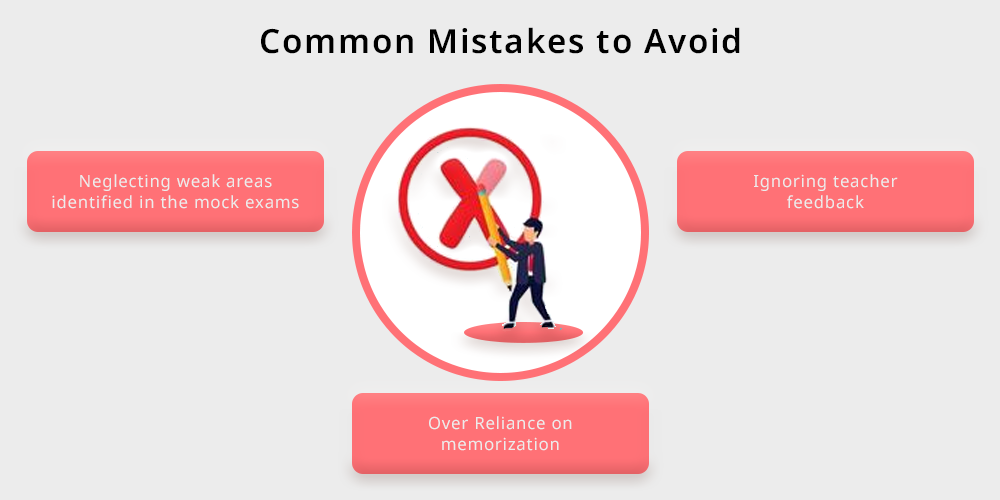
There are a lot of mistakes to avoid in O-level and A-level exams, but a few common of them are:
Mistake 1: Ignoring the Exam syllabus:
One of the biggest mistakes students make is jumping straight into textbooks without reviewing the O-level or A-level syllabus. The syllabus clearly outlines what examiners expect you to study, including topics, assessment objectives, and weightage. Ignoring it means wasting time on irrelevant material and missing high-priority areas. Always use the syllabus as your roadmap.
Mistake 2: Not practicing past papers
Many students underestimate the value of past papers. Practicing them helps you understand exam patterns, question formats, and time management. Without this practice, even well-prepared students may struggle under real exam pressure. Use both past papers and marking schemes to refine your answers and match examiner expectations.
Mistake 3: Procrastination and Poor time management:
Leaving revision to the last minute is a recipe for stress and underperformance. Many students spend too much time on one subject while neglecting others. Create a realistic study schedule, set daily goals, and stick to them. Time management is not only important during revision but also inside the exam hall, allocate time wisely to avoid leaving questions unfinished.
Mistake 4: Relying only on cramming & starting too late:
Some students depend entirely on cramming, memorizing notes without understanding concepts. This backfires in exams where application and critical thinking are tested. Similarly, starting your preparation too late makes it impossible to cover the syllabus effectively. Start early, revise gradually, and focus on conceptual clarity rather than rote learning.
Mistake 5: Leaving MCQs to luck:
In subjects with MCQ (Multiple Choice Questions), many students rush through and guess answers without proper reasoning. This leads to unnecessary loss of marks. Instead, learn elimination techniques, read each option carefully, and avoid random guessing. Remember, MCQs are often the easiest way to secure marks if prepared well.
More mistakes to avoid:
Mistake 5: Neglecting structured revision:
Randomly revising without a clear plan is another common error. Students flip through books or notes but fail to revise systematically. Structured revision, using a timetable, flashcards, mind maps, and spaced repetition, ensures long-term retention. Without this, information slips away before exam day.
Mistake 6: Not seeking professional help:
Some students struggle alone without asking for help. If certain topics seem too difficult, don’t hesitate to get guidance from O-level or A-level tutors. Professional help provides clarity, exam techniques, and targeted feedback that self-study alone may not achieve.
Mistake 7: Not using the Marking scheme & Examiner report:
Examiners provide clear marking schemes and reports after every exam session. Ignoring these is a missed opportunity. They reveal how marks are awarded, common mistakes, and what examiners expect in answers. Using them can significantly improve your exam strategy and answer-writing style.
Mistake 8: Not reading the question properly:
Many students lose marks by rushing and misinterpreting the question. Overlooking command words like explain, compare, evaluate, or analyze can completely change the required answer. Always read carefully, underline keywords, and ensure your answer matches what the examiner is asking.
Mistake 9: Weak writing and presentation skills:
Even if you know the content, poor writing and presentation can cost marks. Untidy handwriting, unorganized answers, and a lack of keywords make it difficult for examiners to award full marks. Structure your answers clearly with headings, bullet points, and examples where needed.
Mistake 10: Ignoring practicals:
Subjects like Physics, Chemistry, Biology, and ICT include practical exams or coursework. Many students neglect these while focusing only on theory. This is a huge mistake because practicals carry significant marks. Practice experiments, learn lab techniques, and review practical past papers to secure higher grades.
Mistakes to avoid on O-level and A-level exam day:
Now that we know the mistakes to avoid in O-level and A-level exams, students should also look for mistakes they make on the exam day.
- Forgetting an important document:
Bringing all the necessary documents that are required is very crucial. Your statement of entry, roll number, and Identity card are important documents that the invigilators check. Missing out on any of them can cause tension and can even delay your exam. The statement of entry for O/A-level students is just like an admit card for AKUEB students. Without it, a student is not allowed to enter the examination hall.
- Not double-checking stationery essentials:
Stationery is an essential item on the exam day checklist. Every student is advised to carry enough stationery to attempt the exam completely. Some subjects require extra stationery, such as a geometry box or a scientific calculator, that should be present with the student on the day of that specific exam.
- Not arriving 30 minutes before the exam:
Managing time on the day of the exam is very important. A few minutes of lateness can lead to the loss of an exam. Leaving your house an hour before the exam can save you your exam as well as time for unexpected delays such as traffic and any unforeseen event. This way, you will reach the exam center at least 25-30 minutes before your exam, and can use this time to prepare your mind, revise, or chat with your classmates.
- Carrying books for revision:
It’s useless to carry books for revision on the day of the exam. Carrying an extra load will make you get tired quickly. Instead, you can carry your revision notes and revise smartly before the exam.
- Skipping breakfast:
Breakfast is the most important meal of your day. Skipping breakfast, especially on the day of an exam, can be dangerous. It can lower your blood sugar level, leading to fainting. Also, you will not be able to focus on your exam on an empty stomach and will experience brain fog. Skipping breakfast can affect your exam performance and can also cause headaches. So it is advised to have a proper breakfast to avoid such mishaps.
- Writing the wrong roll number:
Writing your roll number with full concentration is important. One small mistake can create a lot of problems in your results. Trying to fill up your details on the question paper quickly can lead to this mistake, so it is advised to fill up all the details with proper concentration and also recheck them. The same goes for the answer sheets that you’re provided by the examiners.
How to overcome these mistakes?
Avoiding mistakes is only half the battle; the real success lies in adopting smart strategies that help you perform at your best in O-level and A-level exams. Here’s how you can overcome the most common exam mistakes:
1. Follow the Exam Syllabus Strictly
Download the official syllabus of either Edexcel or Cambridge and follow it. It is your road map. Highlight key topics and assessment objectives so you don’t miss out on anything the examiner expects.
2. Practice past papers regularly:
Past papers are the ultimate tools to prepare for your O-level and A-level exams. Solve them weekly to help learn the exam pattern. Always review your answers using the official marking scheme and read examiner reports to learn where students often lose marks.
3. Build a smart study schedule:
A study schedule including all the important elements such as revision, past papers, marking scheme, and examiner reports. Plan your topics weekly to cover all the topics in the O-level syllabus and the A-level syllabus as well. Instead of last-minute cramming, break your revision into manageable chunks and follow a structured timetable.
4. Focus on conceptual learning:
Work on grasping the core concepts and applying them to different situations. Discuss difficult topics with peers or trusted online tutors and practice applying theories to real-life examples to deepen your understanding.
5. Improve MCQ Strategy:
Multiple-choice questions are not just about luck. Practice elimination techniques to rule out incorrect options and improve accuracy. Solve MCQs under timed conditions to train yourself for exam pressure and analyze past MCQs to identify recurring question trends.
6. Make structured revision techniques:
Random revision often leads to confusion. Instead, create a system using flashcards, mind maps, or concise summaries to reinforce your memory. Revise in cycles like daily, weekly, and monthly to ensure you retain information for the long term.
- Seek Professional Guidance When Needed:
Sometimes, self-study isn’t enough. Seeking help from experienced O-level or A-level tutors can make a huge difference. Professional tutors provide exam-focused strategies, targeted topic explanations, and personalized guidance. At VACE Global, our expert tutors specialize in helping students secure top grades in Cambridge and Edexcel exams.
- Strengthen writing and presentation skills:
Good knowledge must be presented effectively. Practice writing neat, well-structured answers using clear paragraphs, bullet points, and relevant examples. Using subject-specific terminology will not only impress the examiner but also boost your chances of securing higher marks.
Conclusion:
Succeeding in O-level and A-level exams isn’t just about hard work; it’s about working smart and avoiding the common mistakes that cause students to lose marks. From following the syllabus and practicing past papers to mastering exam techniques and seeking the right guidance, every step you take can move you closer to your academic goals.
At VACE Global, we understand the challenges students face during Cambridge and Edexcel exams. Our expert O-level and A-level tutors provide personalized guidance, structured study plans, and exam-focused preparation to help you avoid these mistakes and aim for top grades.
Don’t leave your success to chance. Enroll with VACE Global today and study smarter, not harder, for your O and A-levels.
FAQs:
Q1: What are the most common mistakes students make in O-level and A-level exams?
Students often ignore the syllabus, rely too much on cramming, skip past papers, mismanage their time, and neglect practicals. These mistakes lower exam performance and can be avoided with proper planning.
Q2: How can I manage my time effectively during O-level and A-level preparation?
Create a structured study timetable, break revision into small chunks, and prioritize difficult topics early. Using techniques like the Pomodoro method and spaced repetition can also help.
Q3: Are past papers really helpful for O-level and A-level exams?
Yes, solving past papers is one of the best preparation strategies. They help you understand exam patterns, improve time management, and learn how examiners award marks.
Q4: How can I improve my writing and presentation skills for exams?
Practice writing clear, structured answers with proper paragraphs, bullet points, and subject-specific terms. Neat presentation and logical flow make it easier for examiners to award marks.
Q5: What is the role of practicals in O-level and A-level exams?
Practicals are crucial in subjects like Physics, Chemistry, Biology, and ICT. Ignoring them can result in losing a significant portion of marks, so practice experiments and solve practical past papers.